
Medium-chain triglycerides and emollient esters are chosen for very different reasons depending on the application. This page maps a buyer requirement to the product family that normally fits it, and links straight to the technical data for each grade.
Start from the requirement column, not the product name. Each row points to the product family that is normally specified for that requirement, and to the technical page where the specification, packaging and documentation for that grade are listed. Where two grades could both fit, the enquiry form is the right place to decide between them.
| Buyer requirement | Suggested product | Why this family |
|---|---|---|
| Liquid MCT formulation, general use | MCT Oil (Medium-Chain Triglycerides) | Standard food-grade liquid MCT, typically C8:C10 60:40 or 70:30, used as the default liquid carrier. |
| Pharmaceutical or excipient use | Pharmaceutical Grade MCT Oil | Tighter limit values and a documentation set intended for excipient and regulated formulation work. |
| High-C8 liquid formulation | Glyceryl Trioctanoate (C8 MCT Oil) | Single-component C8 triglyceride, used where a narrow fatty-acid profile matters more than cost. |
| Food formulation, additive route | Caprylic/Capric Triglyceride (ODO) - Food Grade | Food-additive grade caprylic/capric triglyceride for formulations registered on the food-additive route. |
| Powder formulation, dry blend or sachet | MCT 70% Microencapsulated Powder | Spray-dried microencapsulated MCT that flows and disperses where liquid oil cannot be used. |
| Cosmetic emollient, skin feel | Caprylic/Capric Triglyceride (GTCC) - Cosmetic Grade | Cosmetic-grade caprylic/capric triglyceride, a light emollient ester for skin-care and colour cosmetics. |
| Cosmetic emollient, dry or powdery skin feel | Isopropyl Myristate (IPM) · Isopropyl Palmitate (IPP) | The isopropyl esters are the standard low-viscosity emollients for lotions, creams and make-up. |
| Cosmetic emollient, oily or pigment-wetting | 2-Ethylhexyl Palmitate (2EHP) · 2-Ethylhexyl Stearate (2EHS) | Heavier 2-ethylhexyl esters, used for richer skin feel and pigment dispersion. |
Every suggested product above links to its own technical page, where the specification table, packaging options, documents supplied with each batch and the enquiry form are listed together.
In this area the grade of the raw material, not the chemistry, decides whether it can be used. Buyers normally need a defined fatty-acid profile, controlled peroxide value and a documentation set that can be filed with the formulation record. Pharmaceutical Grade MCT Oil and pure C8 MCT oil are the two grades usually requested; the MCT Oil range lists the full set of grades, and the Quality & Compliance page explains how each batch is tested.
Food applications turn on sensory neutrality, oxidation stability and the regulatory route the finished product is registered under. Food-grade liquid MCT and the food-additive grade caprylic/capric triglyceride are the two usual choices, with the ester route used where the additive listing is the simpler path. See MCT Oil (Medium-Chain Triglycerides) and food-grade ODO.
When the finished format is a powder — a sachet, a dry blend, a capsule fill or a beverage premix — liquid oil cannot simply be added without caking. Microencapsulated powder solves that: the oil is spray-dried inside a carrier so it stays free-flowing and dispersible. Choose the load level first: MCT 70% powder for standard loading, high-load MCT powder where a higher oil content is needed, or powdered C8 for a narrow-profile powder. Ketogenic and pet formats have their own grades — ketogenic MCT powder and pet grade MCT powder.
Emollient selection in cosmetics is driven by skin feel, spreading behaviour and compatibility with the rest of the formula. Caprylic/capric triglyceride is the workhorse light emollient; the isopropyl esters give a drier finish; the 2-ethylhexyl esters give weight and pigment wetting. The full list is on the Emollient Esters page.
Sports nutrition, ketogenic and clinical nutrition formats usually need MCT in a convenient form: either a liquid oil blended into a drink or bar, or a microencapsulated powder for a dry mix. Both routes are produced at the same plant, so a single supplier can cover a liquid and a powder SKU. Start from MCT Oil or MCT Powder.
Where none of the standard grades fits exactly — a specific C8:C10 ratio, a defined limit value, a particular carrier in the powder, or a tailored ester blend — formulation requirements can be evaluated against the application. The About Us page describes the manufacturing base, and the enquiry form on this page is the starting point for a custom requirement.
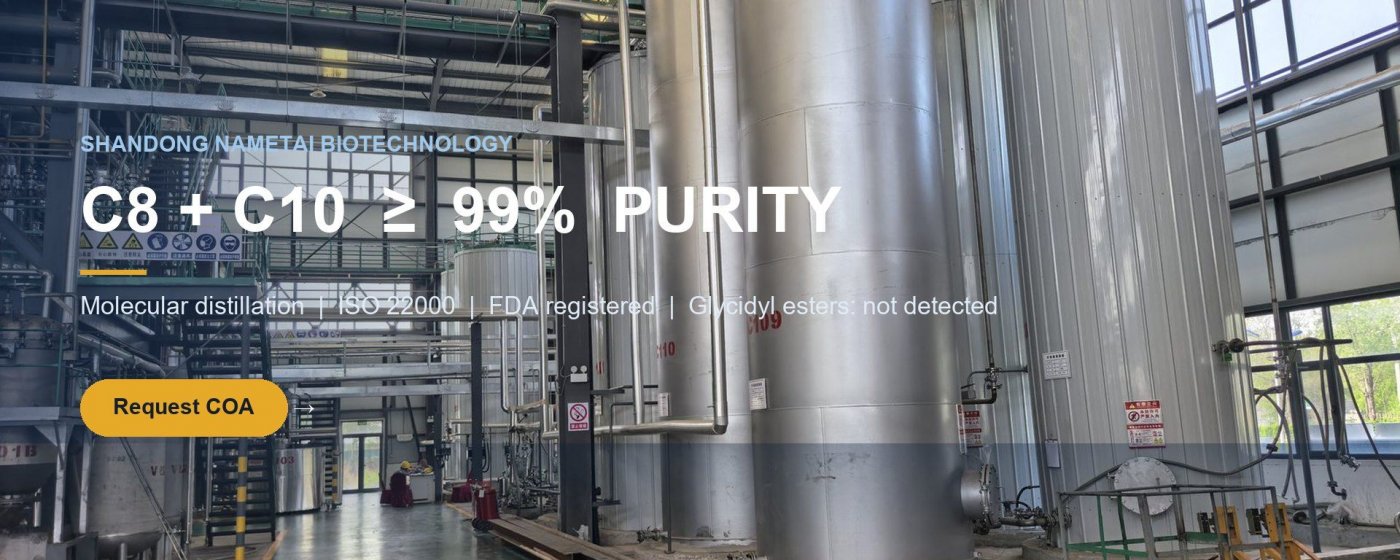
Before requesting a quotation, the two pages most buyers read first are Inside Our Factory (how the plant is laid out and what equipment runs the process) and Certification (which certificates are held and what each one covers). Technical articles on grade selection and batch documents are collected in the Knowledge Hub — starting with What Is MCT Oil? and MCT Oil vs MCT Powder.
For a quotation, a sample or a batch document, use the enquiry form on this page — request a quote — or the Contact Us page.

 +8613295467567