
 +8613295467567




Medium-chain triglycerides (MCT) are a class of fats built from medium-chain fatty acids — chiefly caprylic acid (C8) and capric acid (C10) — esterified onto a glycerol backbone. In commercial terms the name covers a defined family of clear, low-viscosity oils, not a single substance: the exact property set depends on which fatty acids are present and in what proportion.
What "Medium-Chain" Means
Fatty acids are grouped by the number of carbon atoms in their chain. Short-chain fatty acids have fewer than six carbons, medium-chain fatty acids have six to twelve, and long-chain fatty acids have more than twelve. MCT products are built from the C6 to C12 range, but in practice almost all commercial MCT oil is C8 and C10.
That narrow window is what makes MCT oil behave differently from ordinary vegetable oil. The chain is long enough to carry meaningful energy density and to behave as an oil, but short enough that the triglyceride is liquid at room temperature, has low viscosity, and is essentially odourless and tasteless.
C8 and C10: The Two Fractions That Matter
Caprylic acid (C8, eight carbons) and capric acid (C10, ten carbons) are the two dominant fractions. Their ratio is the single most quoted number on an MCT specification, and the reason is that the two behave somewhat differently in formulation:
Caprylic Acid (C8)
C8 is the shorter of the two. It gives the lowest viscosity and the lightest feel, and it is the fraction most often requested when a formulation wants the fastest-clearing, least oily behaviour. Pure C8 products (glyceryl trioctanoate) carry essentially only this fraction.
Capric Acid (C10)
C10 is slightly longer and heavier. It contributes a marginally richer mouthfeel and a higher boiling point, which matters in processing. It is also generally the more expensive of the two fractions to isolate, which is one reason a pure C8 or a high-C10 product costs more than a standard blend.
Blends
Standard MCT oil is normally supplied as a blend, most commonly at a C8:C10 ratio of 60:40 or 70:30. The blend is not a compromise so much as the default commercial product: it delivers the general MCT property set at a workable cost, and most food and supplement formulations are built around it. A 70:30 product simply shifts the balance toward the faster, lighter C8 fraction.
How MCT Oil Is Made
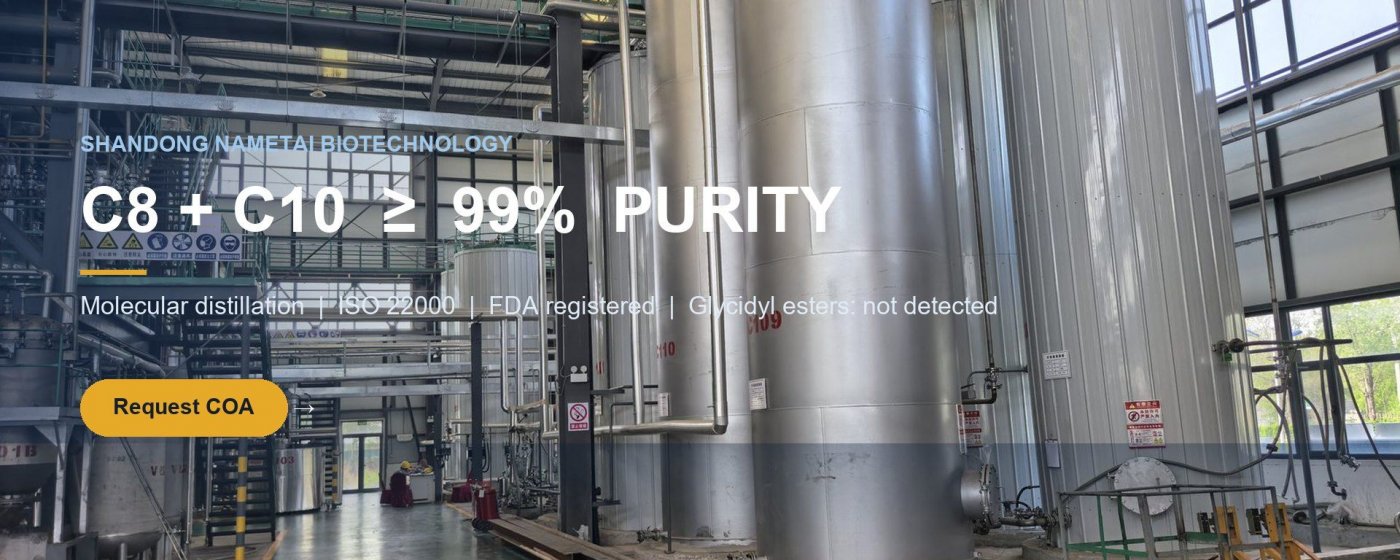
Commercial MCT oil is produced from a suitable triglyceride feedstock — refined coconut oil and palm kernel oil are the usual sources — by splitting the fat into free fatty acids and glycerol, separating the medium-chain fraction, and then re-esterifying the selected fatty acids back onto glycerol. The medium-chain fraction is obtained by distillation, which is why the process is often described as fractionation.
Two process choices then determine the final specification. The first is the distillation cut: how tightly the C8 and C10 fractions are separated, which sets the achievable purity and the ratio. The second is the finishing treatment, which sets the limit values — free fatty acid, peroxide value, colour and moisture. These are the parameters a buyer sees reported on the certificate of analysis. The QC lab article describes the analytical equipment used to measure them.
What Determines Grade
The same chemistry can be sold under several grades, and the difference lies in the limit values and the documentation rather than in the basic structure.
| Grade | Typical use | What distinguishes it |
|---|---|---|
| Food grade | Food, beverage and supplement formulations | Standard limit values; food-additive or food-raw-material route. |
| Pharmaceutical / excipient grade | Regulated formulations and excipient use | Tighter limit values and a documentation set intended for filing. |
| Cosmetic grade | Skin care, colour cosmetics | Specified for emollient performance and colour; cosmetic-grade documentation. |
| Food-additive grade (ODO) | Formulations registered on the additive route | Sold against the food-additive listing rather than as a food raw material. |
| Pure C8 | Narrow-profile liquid formulations | Essentially a single fraction rather than a blend. |
The MCT Oil range lists these grades side by side; this comparison article sets out where the pharmaceutical and food grades actually differ on the test sheet.
Where MCT Oil Is Used
Because MCT oil is liquid, neutral and stable, it is used across a wide range of product types: as a carrier or diluent in food and beverage, as an energy source in sports and clinical nutrition, as the oil phase in cosmetic emulsions, and as an excipient in regulated formulations. The exact product family for a given requirement is mapped on the Applications page. Where a dry format is needed instead, the oil is microencapsulated into a powder — see MCT Oil vs MCT Powder.
How MCT Oil Is Supplied
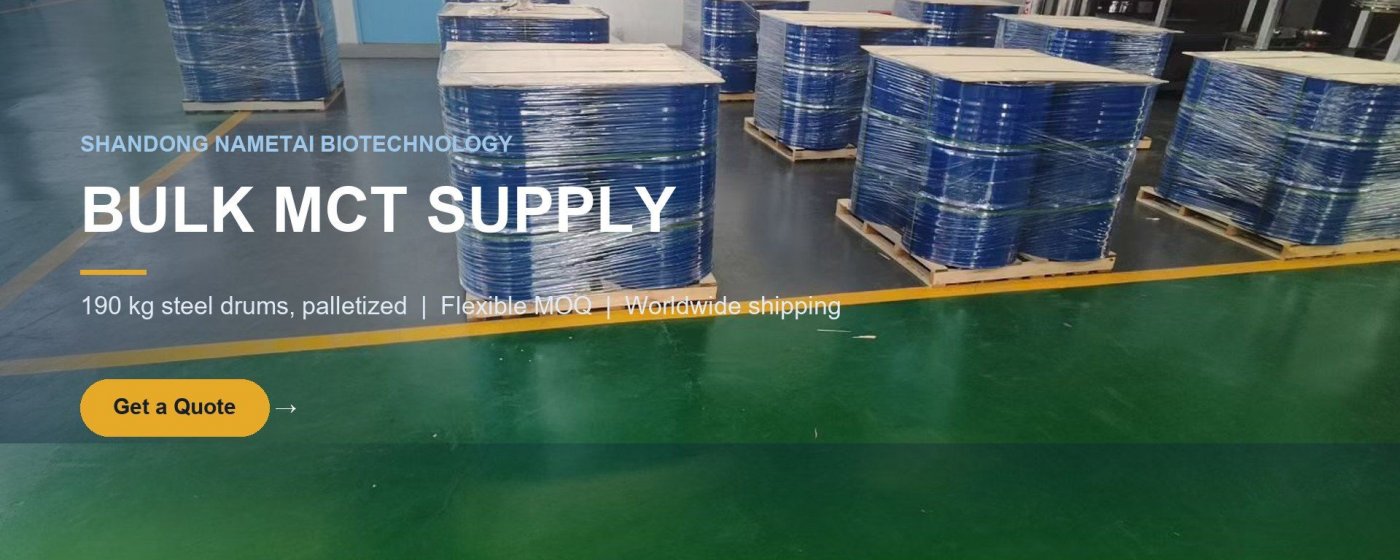
MCT oil is shipped as a bulk liquid in drums and, for larger volumes, in palletised drum loads prepared for container shipment. The minimum order quantity, sample sizes, lead time and packaging options for each grade are listed on the individual product pages, beginning with MCT Oil (Medium-Chain Triglycerides).
Common Questions
Is MCT oil the same as coconut oil?
No. Coconut oil is a naturally occurring fat that contains a mixture of fatty acids, of which only a part are medium-chain. MCT oil is a processed product in which the medium-chain fraction has been isolated and re-esterified, so its composition is far more tightly defined.
Is MCT oil always clear and odourless?
A properly finished MCT oil is clear and practically odourless, which is exactly what makes it attractive in formulations. Cloudiness or an off note usually indicates a problem with the finishing treatment rather than a property of the material.
Does the C8:C10 ratio change the specification sheet?
Yes — it changes the fatty-acid composition row and, indirectly, the physical values such as viscosity and smoke point. It is the first thing worth checking against your own requirement. See C8 vs C10 for how the two fractions differ.
Related Pages
- Products: MCT Oil · MCT Powder · Emollient Esters
- Manufacturing: Inside Our Factory · Quality & Compliance · Certification
- Selection: Applications · Knowledge Hub
Request a Quote
For a quotation, a sample (1 kg or 20 kg) or batch documentation, use the enquiry form on this page — request a quote — or the Contact Us page. The minimum order quantity is 1 kg for MCT Oil, MCT Powder and Specialty Esters.