
 +8613295467567




Buyers meet the words "food grade" and "pharmaceutical grade" on every MCT oil quotation, and the price difference between them is often significant. What is less often explained is what actually changes between the two — which limits tighten, which documents appear, and which regulatory work the grade is expected to support.
This article compares the two grades from a buyer's point of view: what stays the same, what changes, and how to decide which one your application genuinely needs.
The Same Molecule, Different Regulatory Position
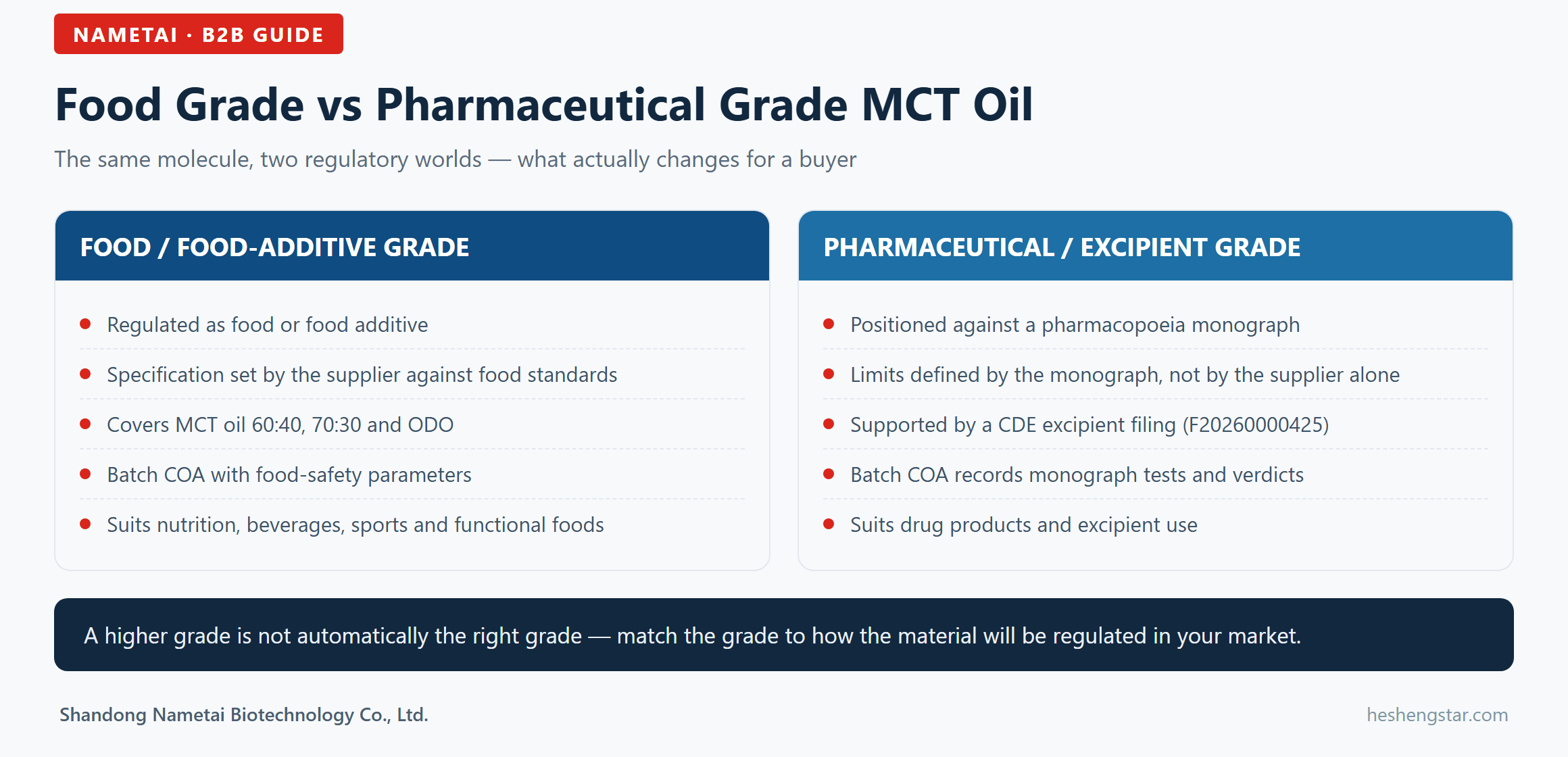
What changes when a grade is positioned against a pharmacopoeia monograph.
Chemically, food-grade and pharmaceutical-grade MCT oil are the same substance: medium-chain triglycerides built from glycerol and caprylic and capric acids. What differs is the regulatory frame each is placed in.
Food-grade MCT oil is regulated as a food or food-additive ingredient. The specification is written by the supplier against applicable food standards, and the batch certificate reports the parameters that frame requires.
Pharmaceutical-grade MCT oil is positioned against a pharmacopoeia monograph. The limits are set by the monograph rather than by the supplier alone, and the batch certificate is expected to record the monograph tests and a verdict against each one. Our article on the ChP 2025 monograph limits and batch release walks through that process in detail.
What Actually Changes for the Buyer
- Where the limits come from. Food grade: supplier-written specification against food standards. Pharmaceutical grade: monograph-defined limits, with the supplier's specification aligned to them.
- What the certificate must show. Both ship with a batch COA; the pharmaceutical COA is additionally structured to demonstrate monograph compliance, row by row.
- The regulatory file behind the grade. For pharmaceutical positioning, the relevant supporting evidence is a CDE excipient filing — for our plant, filing reference F20260000425, recorded in the public excipient register. A filing is a registration record for use as an excipient; it is not a drug approval, and it should not be presented as one.
- Documentation depth. Pharmaceutical use typically draws on a wider pack: specification, TDS, batch COA, and evidence of the filing and plant licences. Our documents checklist lists the full set.
- How it is released. Every batch, in either grade, is tested against its specification before it ships — the process is described on our Quality & Compliance page. The difference is the standard it is tested against.
Evidence You Can Check Yourself
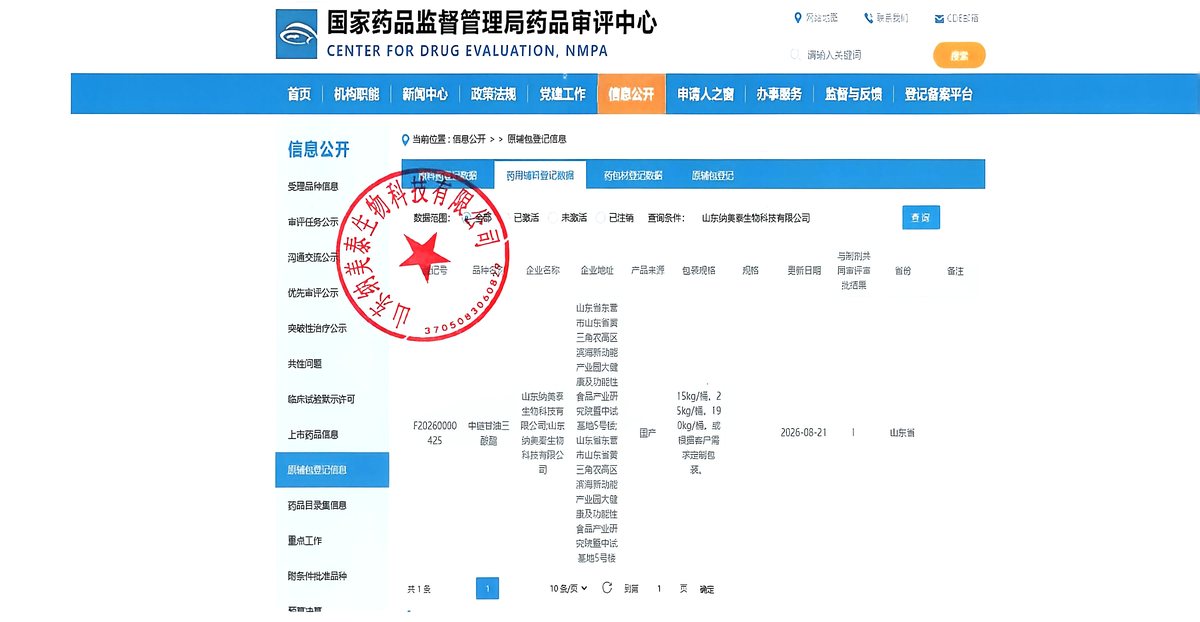
Public filing record for the pharmaceutical-grade product: CDE excipient filing F20260000425.
Grade claims are checkable. A pharmacopoeia positioning can be verified against the published monograph; an excipient filing can be verified in the public register; certificates can be verified with the issuing body. When a supplier describes a grade, ask which document supports the description — and read that document rather than the brochure.
The same discipline applies to the numbers. Our guide to reading an MCT oil COA explains how to match a batch certificate against the specification it claims to satisfy.
Which Grade Does Your Application Need?
The useful question is not "which grade is better" but "how will the material be regulated in my market". A functional beverage is regulated as food, so food-grade MCT oil is the correct positioning — buying a pharmaceutical grade adds cost without changing the regulatory outcome. A drug product that uses MCT oil as an excipient needs the pharmaceutical-grade positioning, because that is what the dossier will be asked to show.
Between the two sit applications that are regulated as food but demand tighter internal limits than the standard requires; for those, a buyer can hold a food-grade product to a stricter specification. That is a legitimate approach — provided the tighter limits are written into the agreed specification, not assumed.
FAQ
Is pharmaceutical-grade MCT oil always safer?
Both grades must meet the food-safety parameters of their frame. The pharmaceutical grade is defined against a monograph and supports excipient use; "safer" depends on the application and the regulation that applies to it.
Does a CDE filing mean the product is approved as a drug?
No. An excipient filing is a registration record in the public register that supports use as a pharmaceutical excipient. It is not a drug approval and should not be described as one.
Can I buy the pharmaceutical grade for a food application?
You can, and some buyers do to hold a single material across lines. The specification you agree remains the document that governs the batch.
Do both grades ship with a batch COA?
Yes. A batch COA is issued with every shipment, in either grade, together with the TDS — with shipment or upon request.
Related Reading
- Pharmaceutical-grade MCT oil: ChP 2025 limits and batch release
- Choosing an MCT oil manufacturer for pharmaceutical applications
- Contaminants in MCT oil: heavy metals, plasticizers, 3-MCPD
Request a Quote
Tell us the application and the market, and we will recommend the grade that matches the regulation rather than the brochure — use the request a quote form. The grades are compared side by side on the MCT Oil family page, and the plant behind them is described in our factory overview.