
 +8613295467567






The fatty acid profile is the row on an MCT oil certificate of analysis that decides whether the oil is what you ordered. It is also the row buyers most often accept without understanding how it was produced. This article explains, in practical terms, how a gas chromatography (GC) test generates the C8:C10 numbers, and what a buyer can and cannot conclude from them.
Why the Profile Matters
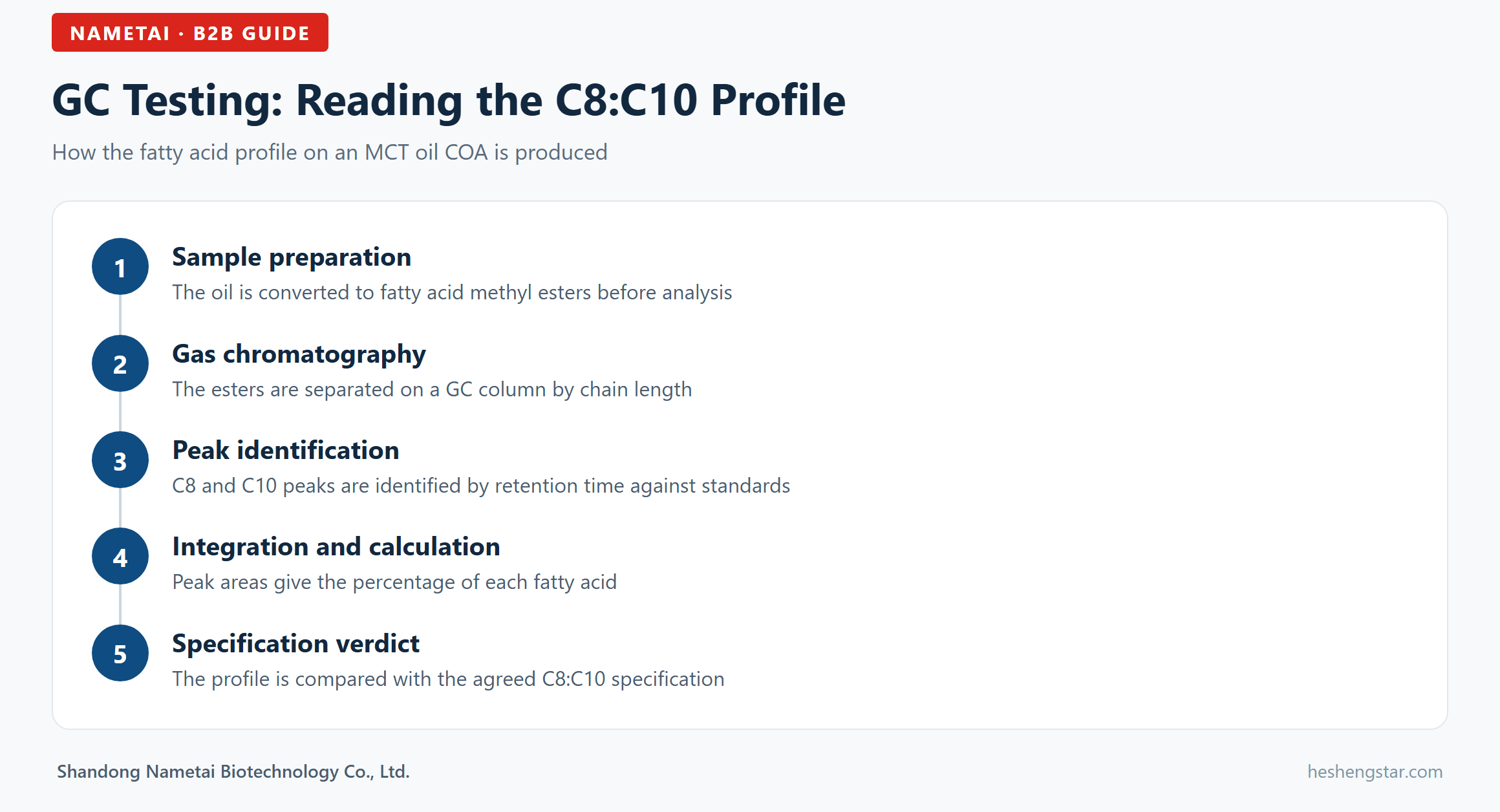
How the C8:C10 numbers on a batch certificate are produced.
An MCT oil is a mixture of triglycerides built from caprylic (C8) and capric (C10) acids. The ratio between them is the property that separates a 60:40 oil from a 70:30 oil, and either from a pure C8 product such as glyceryl trioctanoate. The ratio influences viscosity, cloud point and metabolic behaviour, which is why it belongs on the specification rather than in a brochure.
How the Test Works
Triglycerides are too heavy to separate directly on a standard GC column, so the test converts them first. The practical sequence is:
- Sample preparation. The oil is converted to fatty acid methyl esters (FAMEs), which are volatile enough to travel a GC column.
- Separation. The esters are carried through the column and separate by chain length — the C8 esters and the C10 esters leave the column at different times.
- Identification. Each peak is identified by its retention time, checked against reference standards rather than assumed.
- Integration. The detector turns each peak into an area, and the areas give the percentage of each fatty acid in the mixture.
- Verdict. The calculated profile is compared with the agreed specification, and the result is recorded on the batch COA.
This is the test that stands behind the "C8:C10 60:40" line on a certificate — and it is the reason that line should be read as a measured result, not a product description.
Reading the Result as a Buyer
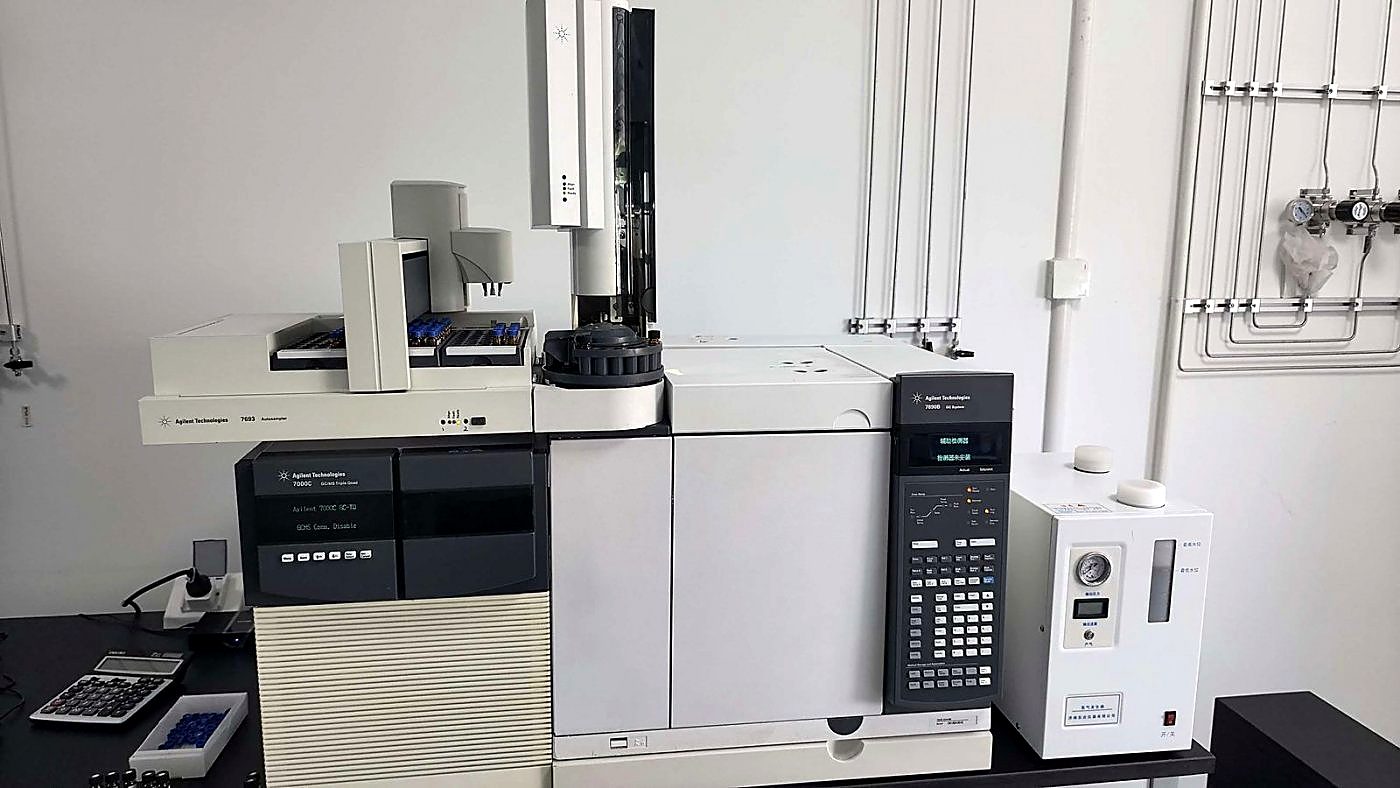
The GC instrument in the Nametai QC laboratory, where batch profiles are measured.
Three questions make the profile row usable:
- Which method? The COA should name the test method. A profile reported without a method cannot be reproduced by your own laboratory.
- Which batch? The profile must be batch-specific. A typical value or a range is marketing information; the batch COA is the document that binds the drum you receive.
- Against which limit? The specification should state the acceptable range for the ratio — for example C8 58–62% for a 60:40 oil. A result without a limit to compare it against is a number, not a verdict.
Our guide to reading an MCT oil COA covers the full certificate row by row; the pure C8 verification guide covers the case where the profile is the whole point of the purchase.
Verifying Independently
A profile measured by the supplier can be verified by anyone with a GC and a reference standard, which makes it one of the easiest claims in the industry to check. Two practical approaches:
- Third-party testing. Send a retained sample from the batch to an independent laboratory and ask for the fatty acid profile by the same or an equivalent method.
- Batch-to-batch comparison. Collect the profiles from several shipments. A stable process produces stable numbers; a drifting profile is a process signal worth raising with the supplier.
Independent verification is normal practice for a new supplier and for any material destined for a regulated application. Asking for it is not an accusation; a manufacturer with a controlled process expects it. If you do visit, ask to see the GC bench — our factory overview describes the plant and the laboratory behind it.
Common Misunderstandings
- "The profile is the oil." It is one property of it. Appearance, acid value, peroxide value, moisture and heavy metals are separate rows with separate limits.
- "Typical value equals batch result." A typical value describes routine production; only the batch COA describes your drum.
- "A higher C8 share is always better." The right ratio depends on the application. Our C8 versus C10 guide explains the trade-offs.
FAQ
Can I verify the C8:C10 profile myself?
Yes. Send a retained sample to a third-party laboratory and request the fatty acid profile by GC. The result should agree with the batch COA within the method's tolerance.
Does the batch COA include the profile?
Yes. A batch COA is issued with every shipment and reports the measured profile against the agreed specification; the TDS is provided with shipment or upon request.
What if two batches give slightly different profiles?
Small variation within the specification range is normal. What matters is that each batch is measured, reported and judged against the same written limit.
Which grades are defined by their profile?
The 60:40 and 70:30 oils, and pure C8 products. The grades are listed on the MCT Oil family page.
Related Reading
- How to read an MCT oil COA
- Buying pure C8 MCT oil: purity and verification
- Contaminants in MCT oil: what to screen for
Request a Quote
If your application depends on a specific C8:C10 profile, send us the ratio and the tolerance you need — use the request a quote form, and the batch COA that ships with your order will report the profile against that limit. The laboratory behind these measurements is described on the Quality & Compliance page.