
 +8613295467567





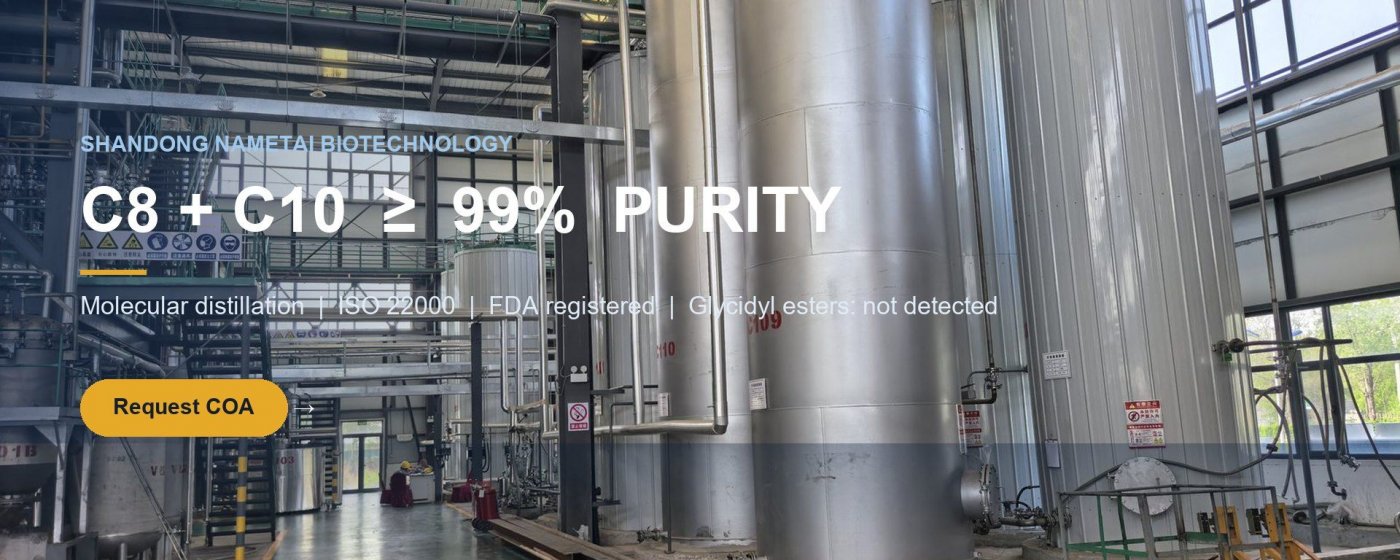
Almost every MCT oil specification leads with a ratio such as 60:40 or 70:30. That ratio describes the balance between caprylic acid (C8) and capric acid (C10), and it is the number that most often decides whether a grade suits a formulation. This article sets out how the two fractions differ and how to choose between them.
What C8 and C10 Actually Are
Both are saturated medium-chain fatty acids, and both are esterified onto glycerol to form the triglycerides that make up MCT oil. The difference is two carbon atoms: caprylic acid has eight, capric acid has ten.
That is a small structural difference with a measurable effect. A shorter chain means lower molecular weight, lower viscosity and a lower boiling point. Because the fractions are separated by distillation, the boiling-point gap is also what makes it possible to produce them at defined ratios at all.
How They Differ in Practice
| Property | C8 (caprylic acid) fraction | C10 (capric acid) fraction |
|---|---|---|
| Chain length | 8 carbons | 10 carbons |
| Molecular weight | Lower | Higher |
| Viscosity | Lower — the lightest MCT fraction | Slightly higher |
| Boiling point | Lower | Higher, which matters in processing |
| Sensory | Lightest, least oily | Marginally richer |
| Relative cost of isolation | Generally lower | Generally higher |
The last row is a commercial rather than a technical point, but it explains much of the pricing structure: because separating out the C10 fraction is more demanding, products that are high in C10, or that isolate a narrow single fraction, carry a higher cost than a standard blend.
The Three Product Positions
Standard blend, around 60:40
The default commercial MCT oil. It carries the general MCT property set — liquid, low viscosity, neutral — at the most workable cost. Most food, beverage and supplement formulations are built around this product, and if no specific reason exists to go elsewhere, this is where to start.
Higher-C8 blend, around 70:30
Shifts the balance toward the lighter, lower-viscosity fraction without going to a single-component product. Chosen where a formulation wants faster, lighter behaviour but still benefits from the cost profile of a blend.
Pure C8
Glyceryl trioctanoate is essentially a single-fraction product. It is specified where the fatty-acid composition has to be tightly defined, or where the lightest possible behaviour is the priority and cost is secondary. Pure C8 MCT oil is the relevant grade.
Note that the reverse position — a pure C10 product — is unusual in commercial MCT supply, for the cost reason given above.
How to Decide
Start from the specification, not the marketing
The ratio should be stated on the specification sheet as part of the fatty-acid composition, next to the individual C8, C10 and total MCT figures. If a supplier quotes a ratio in conversation but the composition row does not support it, ask why.
Check whether the ratio actually matters for your product
For many applications the difference between 60:40 and 70:30 is small relative to other formulation variables, and a blend is the pragmatic choice. The ratio becomes decisive when the fatty-acid profile is part of a regulatory filing, when a label makes a specific claim, or when the physical property affected by chain length — typically viscosity or volatility — is genuinely critical to the process.
Match the grade, not just the ratio
Two products can share a ratio and still differ in grade: the limit values and documentation set are what make a material usable in a regulated product. This article covers where the pharmaceutical and food grades diverge.
Checking the Number on a COA
On the certificate of analysis, look at the fatty-acid composition block. A well-constructed sheet reports the C8 and C10 figures separately rather than only a total MCT percentage, because the total alone does not tell you the balance. The full set of parameters worth checking is covered in How to Read an MCT Oil COA.
Common Questions
Is pure C8 always better?
No. It is better matched to requirements that specifically call for a narrow C8 fraction or the lightest available behaviour. For general use, a blend delivers the MCT property set at a lower cost, and there is no benefit in paying for purity the formulation does not use.
Does the ratio affect shelf life?
The ratio affects physical properties such as viscosity and volatility more directly than stability. Stability is driven mainly by the finishing treatment and by how the material is packaged and stored, which is why peroxide value and packaging both appear on the specification.
Can I get a ratio that is not 60:40 or 70:30?
Blending to a specified ratio is a normal part of the process, so non-standard ratios can generally be discussed. The practical constraint is cost: pushing the C8 content very high approaches the pure-C8 position and its price. Custom requirements of this kind are evaluated against the application; the Applications page and the enquiry form are the starting points.
Related Pages
- Products: MCT Oil · MCT Powder · Emollient Esters
- Manufacturing: Inside Our Factory · Quality & Compliance · Certification
- Selection: Applications · Knowledge Hub
Request a Quote
For a quotation, a sample (1 kg or 20 kg) or batch documentation, use the enquiry form on this page — request a quote — or the Contact Us page. The minimum order quantity is 1 kg for MCT Oil, MCT Powder and Specialty Esters.