
 +8613295467567



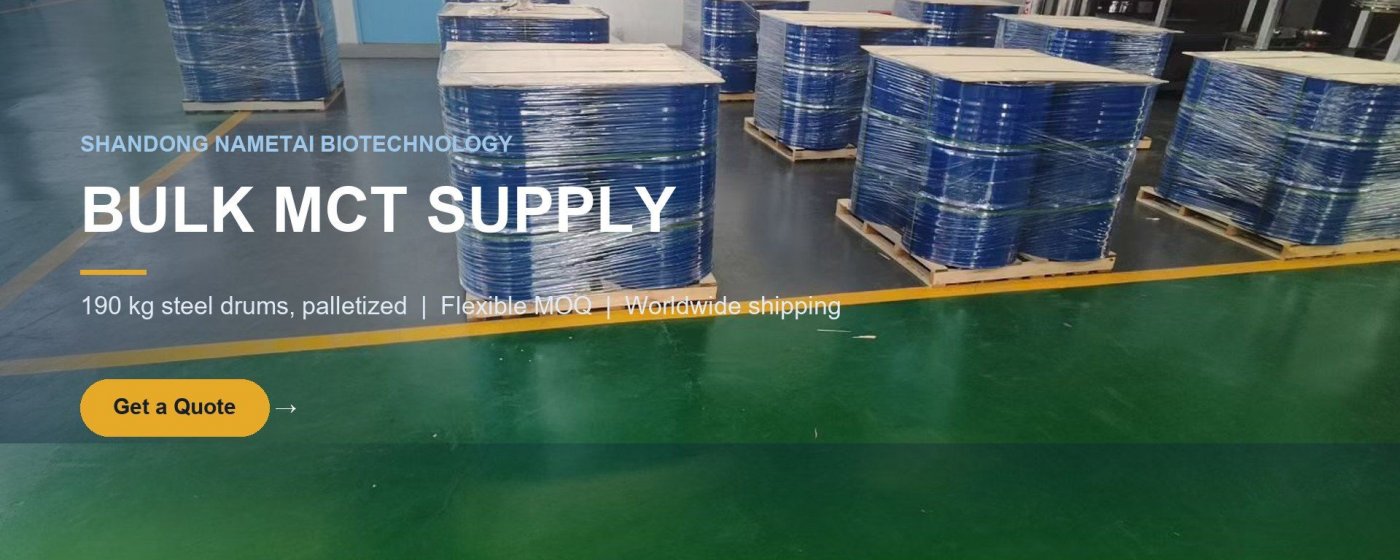

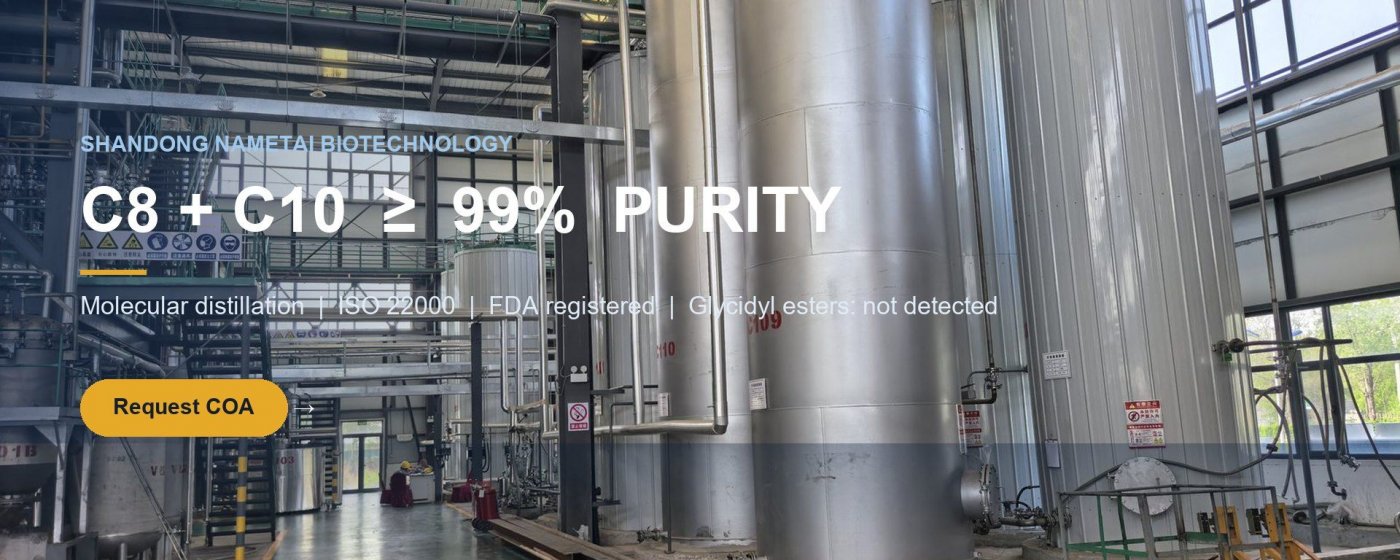
A 1 kg sample tells you almost nothing by itself. What makes a sample program valuable is the documentation that travels with it and the checks you run against it. This article lays out a practical evaluation sequence for MCT oil samples — from the moment a sample arrives to the moment you release a production order — based on the batch documentation we actually ship.
Start from the sample policy, not the sample
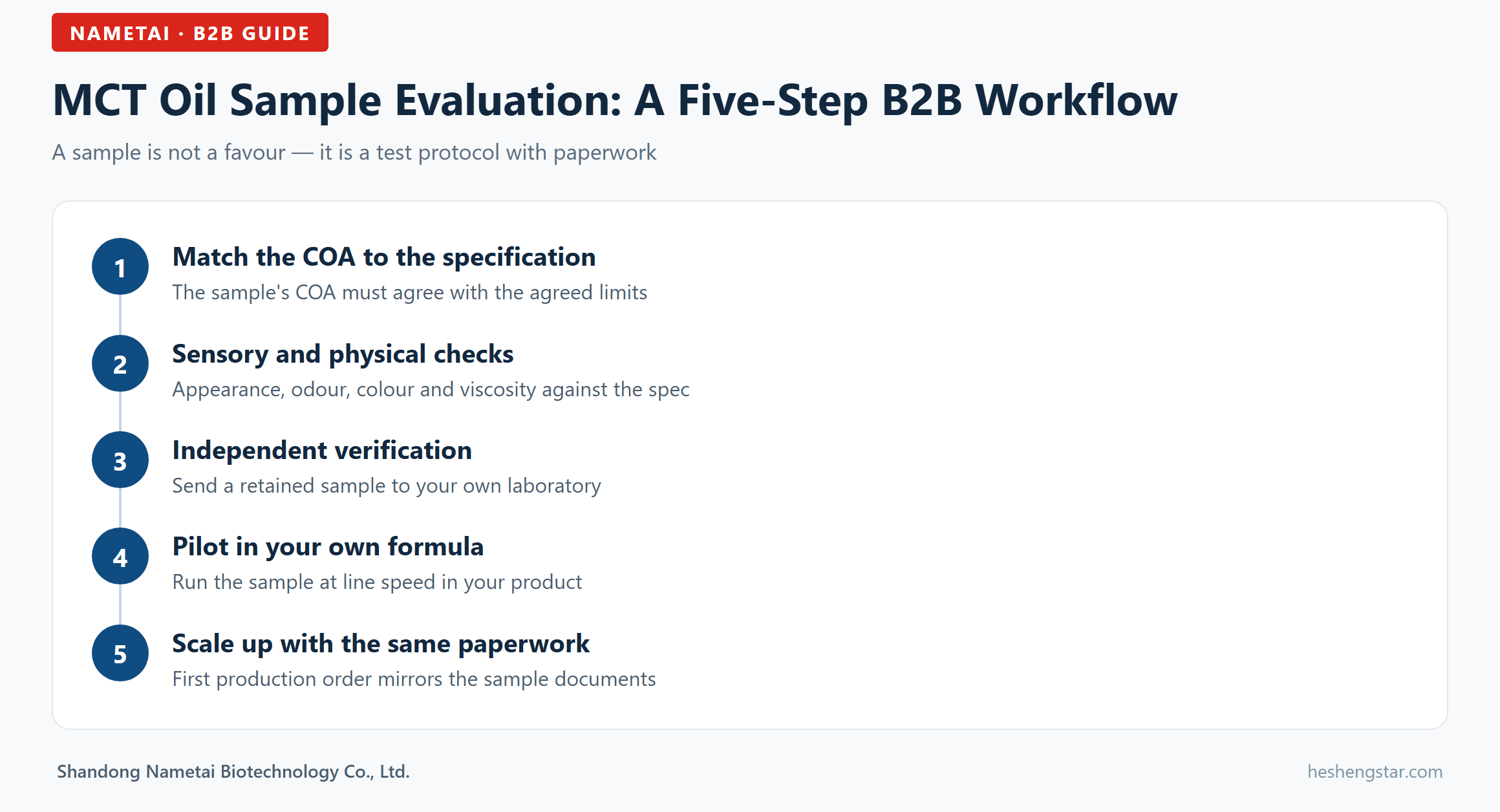
Five steps from receiving the sample to scaling up with confidence.
Before comparing suppliers, compare their sample terms, because they reveal how the supplier treats batch documentation. Our policy: samples are available in 1 kg or 20 kg quantities, and sample quantities can be customised to the buyer's requirement. Every sample is accompanied by the batch COA of the exact batch the sample came from — not a generic brochure certificate. The minimum order quantity is 1 kg across MCT Oil, MCT Powder and Specialty Esters, which means the first production batch can be as small as the sample you started with.
If a supplier sends a sample without a batch-specific COA, or cannot say which production batch the sample represents, you have already learned something important about their traceability.
Step 1: match the COA to the specification
Open the COA before you open the drum. Check three things in order:
- The batch number on the COA is the batch number on the sample packaging.
- Every parameter on the supplier's specification sheet appears on the COA with an actual result — not "complies".
- The tested values sit comfortably inside the specification limits, not on the edge.
For our food-grade MCT oil, typical values come from routine production batches (for example, batch NMT-260601: C8:0 56.98%, C10:0 42.37%, acid value 0.04 mg KOH/g, peroxide value 0.28 mmol/kg). The specification table on the product page lists standard values and typical values side by side, precisely so buyers can see how much margin the process normally holds. The distinction matters: specification values are the standard's requirement; typical values are indicative only, and the batch COA carries the actual results for the batch you receive.
Step 2: run your own sensory and physical checks
MCT oil should be a clear, colourless to slightly yellowish oily liquid with no special odour. On receipt, check appearance and odour against the specification, and record what you observe. Simple checks catch most transport and storage problems:
- Appearance: clarity and colour against a fresh reference.
- Odour: neutral, no off-notes suggesting oxidation.
- Packaging condition: drum integrity, seal condition, labelling with batch number.
If anything looks wrong at this stage, flag it to the supplier while the goods and documentation are still in the claims window — a supplier's response to a problem sample is itself evaluation data.
Step 3: independent verification of the numbers
Our own release testing covers the full specification: fatty acid composition by gas chromatography, acid value, peroxide value, moisture and impurities. Heavy metals, plasticizers and microbiology are verified by a third-party laboratory (CTI) rather than claimed in-house, and retained samples of every batch are kept for traceability back to production records.
For your side of the table, two options exist. You can commission your own third-party laboratory on the sample — we support this and provide the full batch documentation alongside. Or you can compare the batch COA against the third-party reports we provide on request. Either way, the goal is the same: your acceptance decision rests on tested values, not on trust.
For buyers who want to see how our routine testing works before spending lab budget, the article on our QC laboratory shows the Agilent 7890B GC system and a real batch test sequence.
Step 4: pilot the sample in your own formula
Numbers qualify the oil; your formula qualifies the oil for you. Run the sample through your actual application — beverage, supplement, bakery, cosmetic — at the dosage you plan to use. Watch for the practical properties MCT oil is chosen for: flavour neutrality, dispersibility, and stability over your product's shelf life. If C8:C10 ratio matters to your application, confirm the ratio on the COA and consider testing both our 60:40 and 70:30 standard grades, or the pure C8 grade, in the same pilot.
Sample quantities can be customised, so a pilot does not have to be squeezed into a single kilogram. For larger formulation trials, the 20 kg sample size exists precisely for that purpose.
Step 5: scale up with the same paperwork
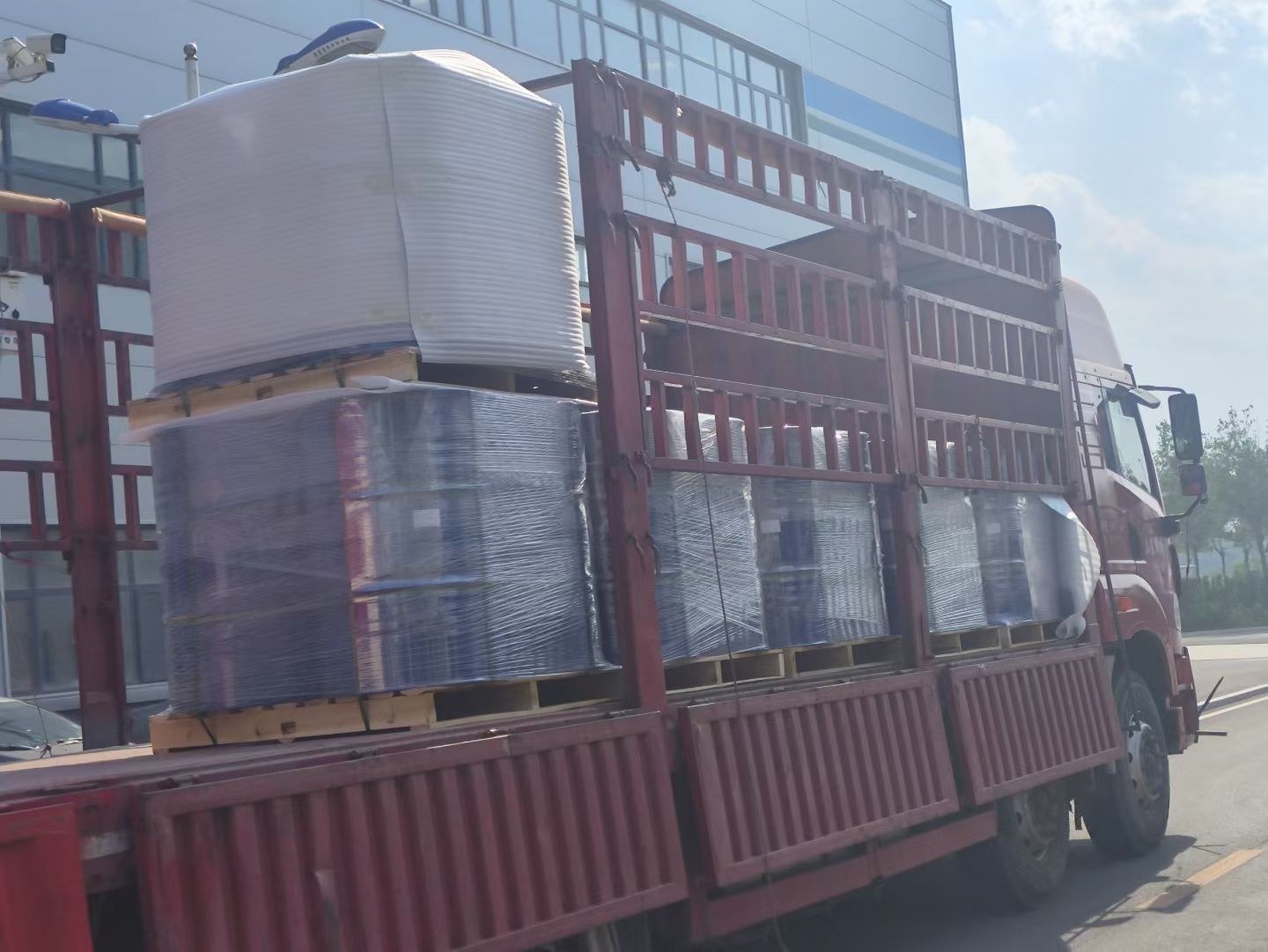
Scale-up works because the paperwork stays identical from sample to first order.
The transition from sample to production order should not change the documentation routine. Every order — sample or full container — ships with a batch COA carrying actual test results; TDS is provided with shipment or upon request, and third-party laboratory reports are available when needed. Regular orders ship within 7 days to the port of departure; OEM and custom orders within 30 days. Payment terms are agreed upon according to the contract between both parties.
If your evaluation is part of a larger supplier-selection exercise, our articles on the documents to request from an MCT oil supplier and how to choose an MCT oil manufacturer for pharmaceutical applications cover the file-by-file and audit-side checklists.
Frequently asked questions
What size sample should I request?
For a bench check and COA review, 1 kg is enough. If you need to run pilot production or shelf-life trials in your own facility, request 20 kg — sample quantities can be customised to your requirement, so ask for what the trial actually needs.
Does the sample come with the same documents as a production order?
Yes. Each sample ships with the batch COA of the batch it was drawn from, and TDS and third-party reports are available on the same basis as for production orders. The documentation does not change between sample and commercial quantity.
Can you match a sample to a specific production batch?
Yes — that is the point of the batch COA. The batch number on the COA matches the batch number on the drum label, and retained samples allow any later question to be traced back to production records.
How fast can a sample reach my market?
Sample orders ship within 7 days to the port of departure, depending on quantity. Contact the sales team with your market and quantity for the specific schedule.
What if my own lab results differ from the COA?
Tell us, with the batch number and your method references. Retained samples and production records allow the result to be investigated batch by batch. A supplier that can trace and explain its numbers is worth more than one that never gets tested.
Related reading
For the product behind this workflow, see the MCT Oil (Medium-Chain Triglycerides) product page. For COA interpretation, see How to Read an MCT Oil COA. For the production environment, see the factory page and Quality & Compliance.
Ready to start an evaluation? Request a sample with its batch documentation through the enquiry form on this page — request a quote.