
 +8613295467567




When buyers search for "pure C8 MCT oil", they are usually comparing two very different products that both get called "MCT oil". One is a blend of caprylic (C8) and capric (C10) triglycerides. The other is a single compound: glyceryl trioctanoate, built almost entirely from C8. This article explains what a B2B buyer should verify before committing to a pure C8 grade, and how to check the paperwork batch by batch.
What "pure C8" actually means
Conventional MCT oil is a mixture: our standard grades are 60:40 and 70:30 C8:C10, produced from palm or coconut oil. A pure C8 grade removes the C10 fraction and concentrates the triglyceride so that glyceryl trioctanoate is the dominant molecule. Because it is closer to a single compound than a blend, a true pure C8 product can be specified much more tightly — and that is exactly what a buyer should demand.
On the market, "C8 oil" can mean anything from a 90% C8 blend to a ≥95% C8 triglyceride. The difference matters for formulation: ketone conversion, flavour neutrality and flow behaviour all depend on how much C10 and longer-chain material remains in the oil. If a supplier's specification sheet does not state a C8 minimum, the product is a blend, whatever the marketing name says.
The identity facts to check first
Before any performance discussion, confirm the identity of the substance on the specification sheet. For our own grade, the product page lists the identity data in full; the table below reproduces the key rows.
| Item | Details |
|---|---|
| Chemical name | Glyceryl Trioctanoate (Glyceryl Tricaprylate) |
| Alias | C8 Oil / C8 Triglyceride |
| Molecular weight | 386.52 g/mol |
| CAS No. | 538-23-8 |
| EINECS No. | 208-688-4 |
If a quotation for "pure C8" does not carry a CAS number and a molecular weight, treat it as a blend until proven otherwise. These two rows take thirty seconds to check and eliminate the most common misunderstanding at the quotation stage.
Specification limits that matter for a pure C8 grade
A credible specification states a limit for each parameter and, ideally, a typical value from routine production so you can see how much margin the process actually has. Our pure C8 grade is specified as follows, with typical values from production batches shown alongside.
| Item | Unit | Specification | Typical value |
|---|---|---|---|
| Appearance | — | Colourless or light yellow | Colourless |
| Odour & taste | — | No special odour | No special odour |
| Acid value | mg KOH/g | ≤ 0.5 | 0.02 |
| Peroxide value | mmol/kg | ≤ 1.0 | 0.036 |
| Moisture & volatile matter | % | ≤ 0.1 | 0.06 |
| Insoluble impurities | % | ≤ 0.05 | 0.01 |
| Caprylic acid (C8:0) | % | ≥ 95 | 96.6 |
| Plasticizer DBP | mg/kg | ≤ 0.3 | Not detected |
| Plasticizer DEHP | mg/kg | ≤ 1.5 | Not detected |
| Plasticizer DINP | mg/kg | ≤ 9.0 | Not detected |
Three rows deserve special attention. The C8:0 row is the identity of the product: ≥95% with a typical value of 96.6% tells you the fractionation process genuinely separates C8 from C10, with real margin — not a 95.0% result that never repeats. The acid and peroxide value rows describe hydrolytic and oxidative freshness; low typical values (0.02 mg KOH/g and 0.036 mmol/kg in our case) indicate both a fresh product and a process that stays well inside its own limits.
How to verify a batch against the specification
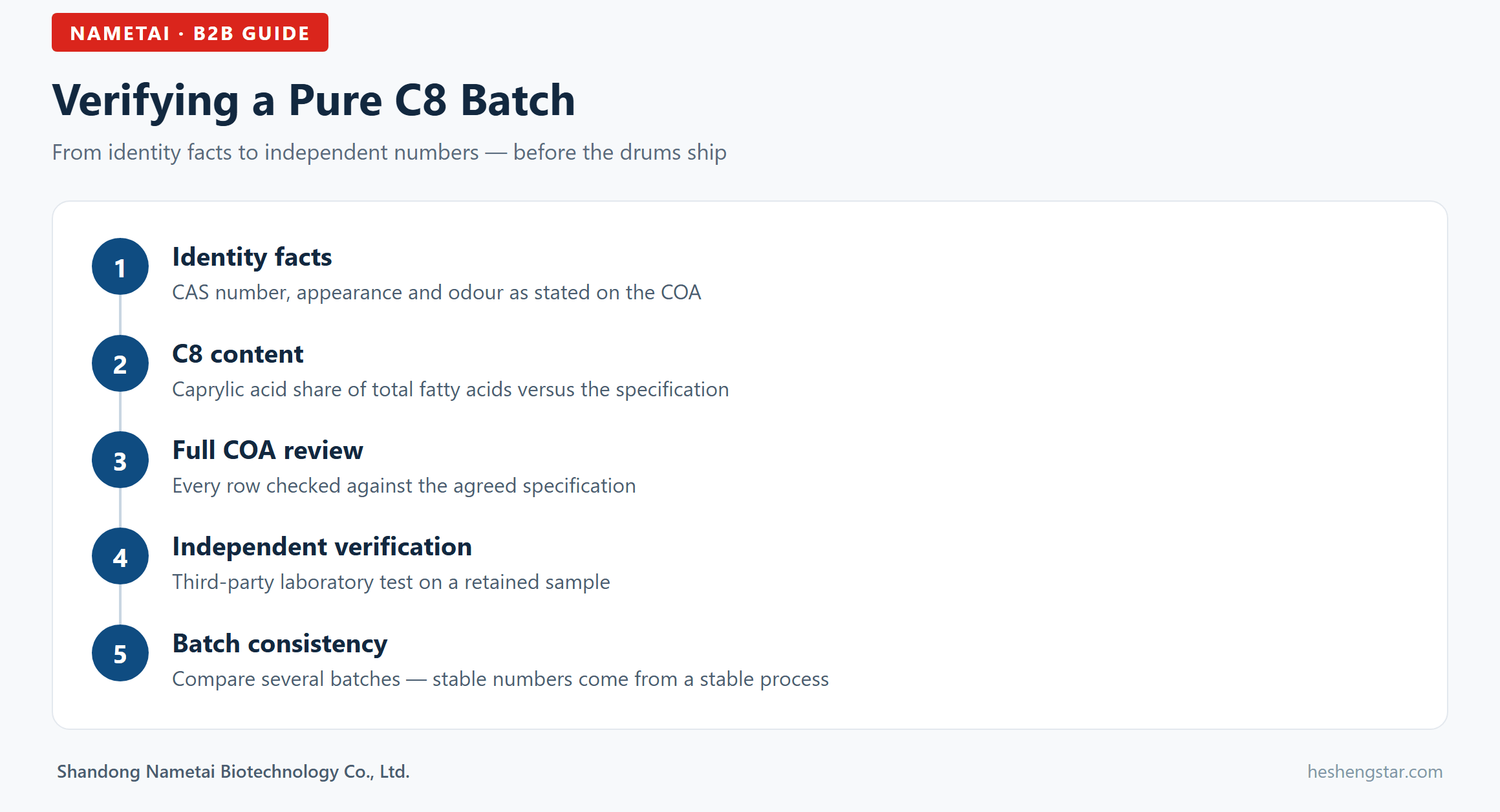
Verifying a pure C8 batch: from identity facts to independent numbers.
The specification sheet is a promise; the batch COA is the evidence. For every shipment, compare the COA against the specification row by row. In practice we recommend this sequence:
- Check the C8:0 result by gas chromatography against the ≥95% limit, and confirm the method reference is stated on the COA.
- Check acid value and peroxide value — these two move fastest if storage or handling has gone wrong.
- Check moisture and insoluble impurities, which reveal contamination and drying performance.
- Confirm the batch number on the COA matches the drums received, and that the report is signed and dated.
If you want a deeper walkthrough of the individual COA parameters, our article on how to read an MCT oil COA explains the limits parameter by parameter, and the ten COA parameters that matter most are summarised separately for quick screening.
Why the numbers stay consistent: the process behind the grade
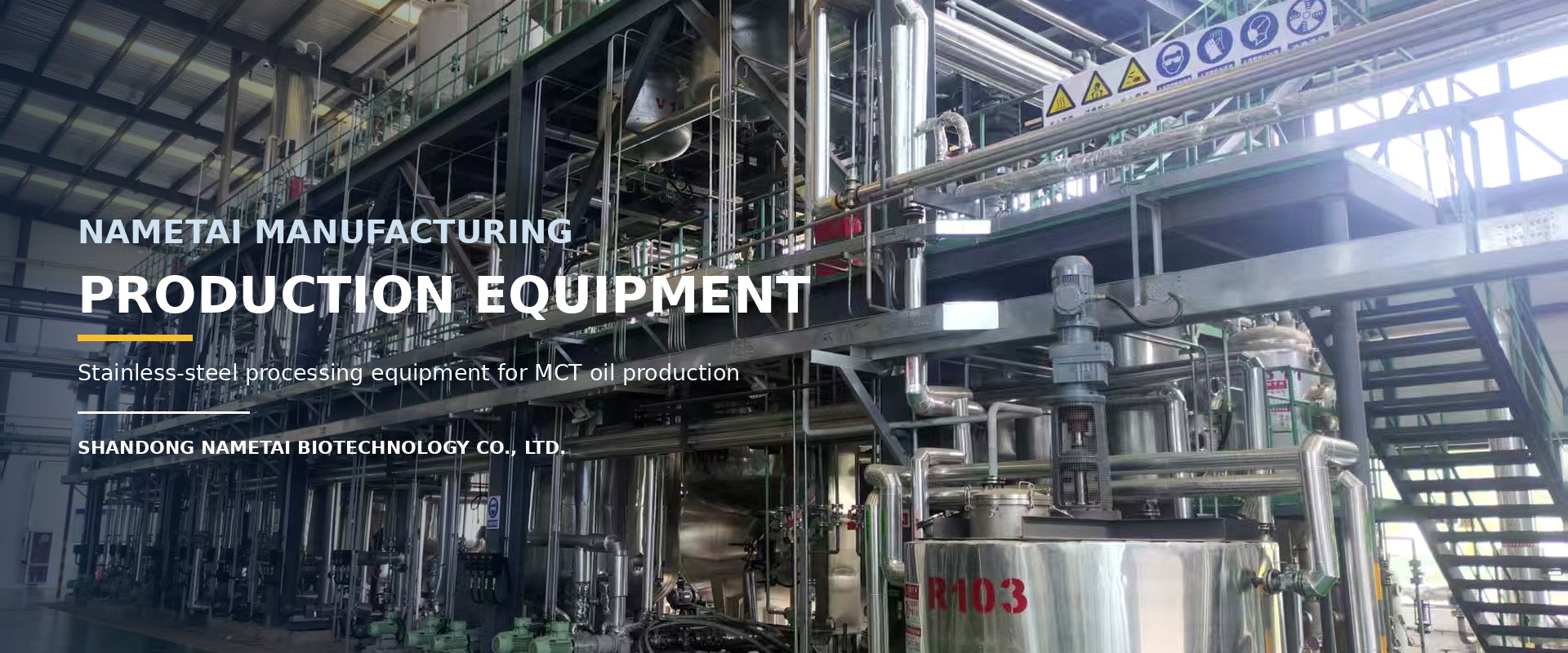
Stable numbers come from a stable, controlled process.
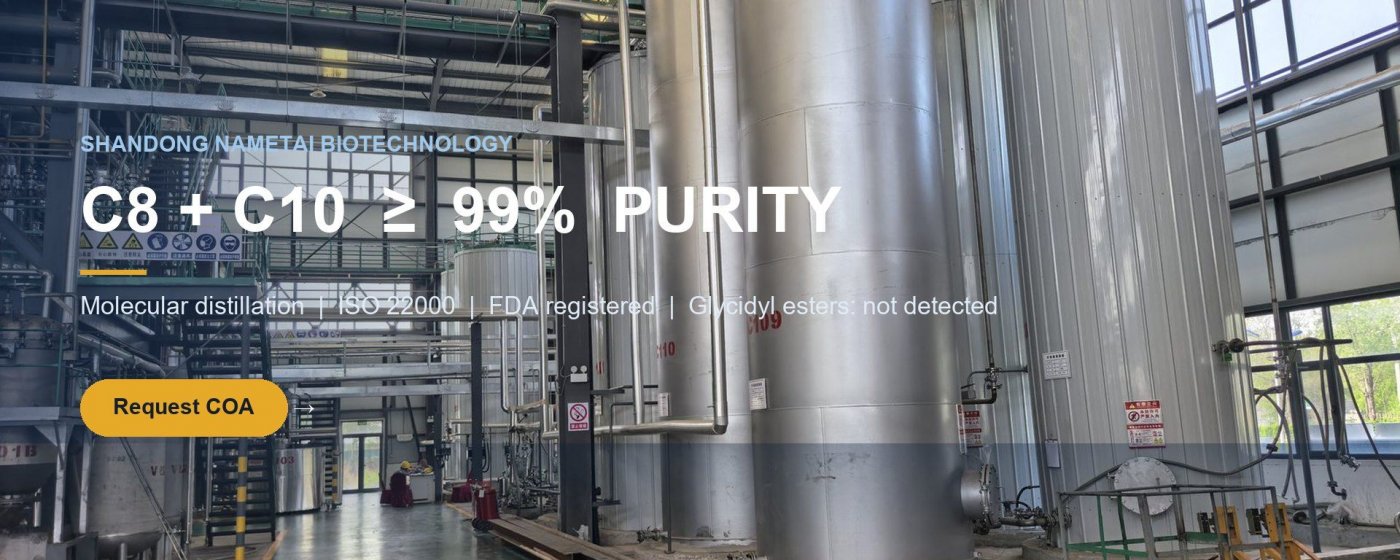
A tight specification is only repeatable if the process behind it can hold the separation. Our pure C8 grade is produced at our Dongying, Shandong base using esterification and molecular distillation, in the same facility that produces our blended MCT oil grades. Every batch is released by our in-house QC laboratory, and heavy metals, plasticizers and microbiology are verified by third-party laboratory reports.
If you want to see the equipment and the routine batch testing in detail, we document it in the article on our QC laboratory and its Agilent 7890B gas chromatography system. Buyers are also welcome to audit the facility in person or by video walk-through — the factory page shows the production environment as it is.
Blended or pure C8: choosing the right grade
Pure C8 is not automatically "better"; it is more specialised. Blended MCT oil (60:40 or 70:30 C8:C10) is the mainstream choice for food, beverage and nutraceutical applications where cost-performance matters. Pure C8 makes sense when the formulation specifically benefits from the shorter chain: rapid ketone conversion in ketogenic products, or where the label claim is specifically C8. Our overview of C8 vs C10 explains the functional differences between the two fatty acids, and our blended MCT Oil (Medium-Chain Triglycerides) page covers the standard grades.
If you decide pure C8 is the right direction, the Glyceryl Trioctanoate (Pure C8) product page carries the full specification, packaging and commercial terms.
Commercial terms for a trial order
The minimum order quantity is 1 kg for MCT Oil, MCT Powder and Specialty Esters, and samples are available in 1 kg or 20 kg quantities. Regular orders ship within 7 days to the port of departure; OEM and custom orders within 30 days. A batch COA with actual test results is issued with each shipment, and TDS is provided with shipment or upon request. Payment terms are agreed upon according to the contract between both parties.
Frequently asked questions
Is glyceryl trioctanoate the same as MCT oil?
Glyceryl trioctanoate is one specific triglyceride (the pure C8 compound, CAS 538-23-8). "MCT oil" usually refers to a blend of C8 and C10 triglycerides. A pure C8 grade is a subset of the MCT family, not a synonym for it — always confirm which one a quotation refers to.
What C8 content should a genuine pure C8 grade show on the COA?
A meaningful pure C8 grade specifies caprylic acid at ≥95% by GC, with typical values clearly above the limit — our production batches typically show 96.6%. If the specification sheet only says "MCT oil, high C8 content" without a number and a method, treat it as a blend.
Can I get a pure C8 sample before scaling up?
Yes. Samples are available in 1 kg or 20 kg quantities, with each accompanied by its batch COA. Many buyers run a small pilot against their formula before committing to production volumes; the MOQ of 1 kg also allows a low-risk first production batch.
How is pure C8 packed for export?
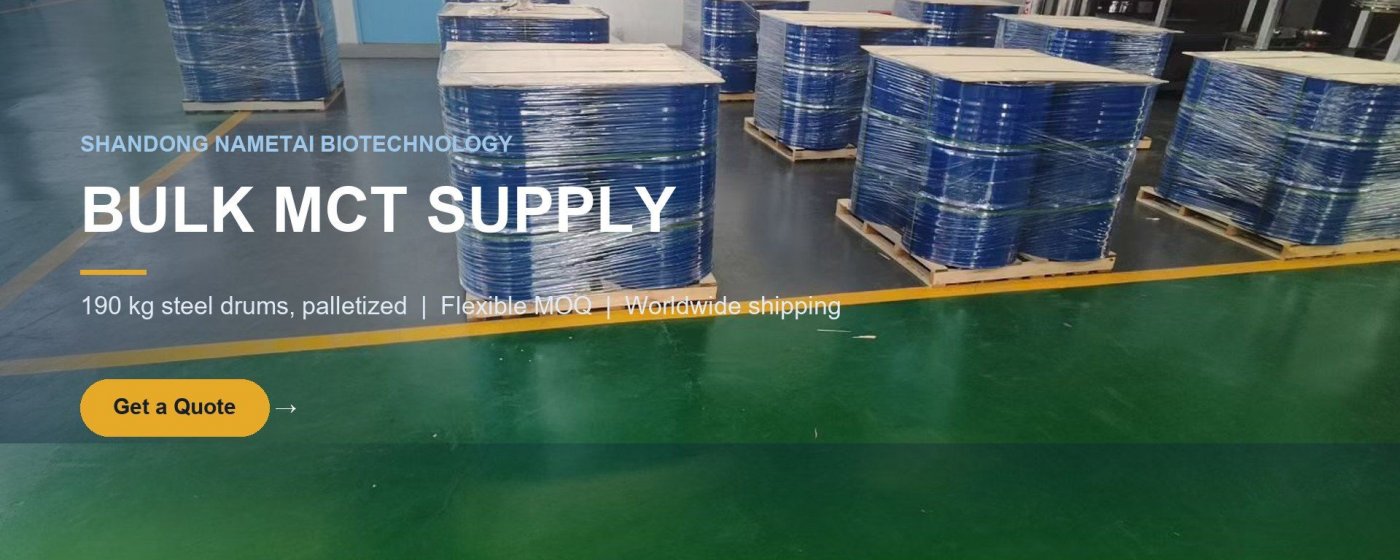
Standard packing is 190 kg iron drums for bulk, with smaller pack sizes available for trials. Bulk shipments can be arranged with four drums per pallet, stretch-wrapped for container loading.
Do you support third-party testing of the sample?
Yes. Our routine release already includes third-party verification of heavy metals, plasticizers and microbiology. Buyers may also commission their own third-party laboratory on the sample — we support sample evaluation with full batch documentation.
Related reading
For the background on how C8 and C10 differ functionally, see C8 vs C10 MCT Oil. For the blended grades, see MCT Oil (Medium-Chain Triglycerides). For quality system detail, see Quality & Compliance and Certification.
Ready to evaluate a pure C8 grade against your formula? Request a quotation, a batch COA or a 1 kg sample through the enquiry form on this page — request a quote.