
 +8613295467567



Sourcing MCT oil from China is not difficult in itself. What is difficult is the part that has nothing to do with the oil: working out whether the company you are talking to actually makes the material, whether the specification you were quoted is the specification that will ship, and whether the paperwork will survive contact with your own quality department. This guide walks through that sequence in the order a real sourcing project encounters it, for buyers who have already decided that China is a plausible source and want to run a disciplined evaluation.
Why Source MCT Oil from China?
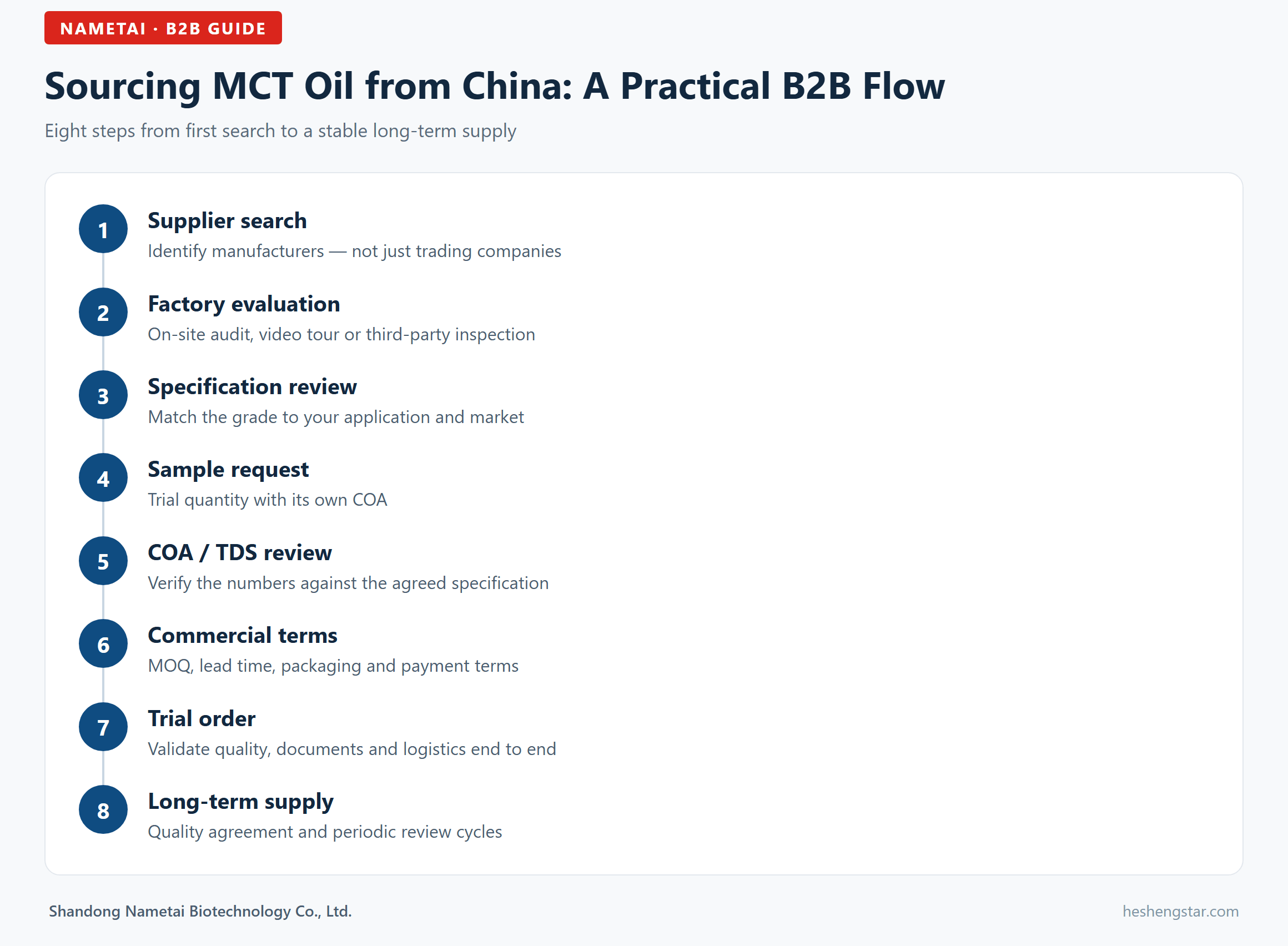
From supplier search to long-term supply: the eight-step sourcing flow.
It helps to be precise about what China offers, because the vague version of this section is where sourcing projects go wrong. Medium-chain triglycerides are produced by fractionating and esterifying the medium-chain fatty acids obtained from palm kernel oil and coconut oil. China has a substantial fats-and-oils processing base, and MCT production sits within it: fractionation, esterification, distillation and separation capacity exists domestically, and the resulting material is supplied into food, nutrition, cosmetic and pharmaceutical applications. What follows from that is narrower and more useful than a general claim about price. Three things are genuinely worth evaluating:
- Supply availability and range. A well-established processing base supports a range of grades rather than a single cut — food-grade and cosmetic-grade material, purer C8 grades, microencapsulated powders, and pharmaceutical-grade oil released against a pharmacopoeial standard.
- Documentation maturity varies sharply between suppliers. This is the main differentiator, not the oil. Two producers can make comparable material and be very different suppliers, depending on whether they can produce a batch-level certificate with measured values, handle a third-party audit, and support a regulatory dossier.
- The regulatory framework is checkable from outside. For pharmaceutical excipients, China's regulatory reform replaced standalone excipient approvals with a public filing platform operated by the Center for Drug Evaluation, so a buyer can independently verify a manufacturer's filing before relying on it.
What is not claimed here: that Chinese MCT is automatically cheaper, or better, or worse. Those are conclusions each buyer has to reach on their own specification, application and qualification process.
1. Decide What Type of MCT Oil You Need
Before evaluating suppliers, fix your own requirement; suppliers can tell when a buyer has not, and the resulting conversations waste weeks. Four questions define most MCT requirements:
- Which grade? Food-grade, cosmetic-grade and pharmaceutical-grade MCT are the same molecule released against different standards, with different documentation. If the material will enter a regulated product, that choice is the first decision, not a later refinement.
- Which composition? Standard C8:C10 blends are typically offered around 60:40 and 70:30; a pure C8 grade is a different product with different behaviour and a different price basis. Decide from your formulation, not from which ratio sounds more premium.
- Which physical form? Liquid oil and microencapsulated powder are not interchangeable. Powder exists for dry formats — sachets, stick packs, dry blends, tablets and hard capsules — where a liquid cannot be used, at the cost of a carrier that appears on the label as an ingredient and, if it is sodium caseinate, as a milk allergen.
- Which end use? Your application determines which specification parameters are critical. A buyer who knows which three parameters matter most to their formulation gets useful answers; a buyer who asks for "the spec" gets a brochure.
Write the requirement down as a one-page target specification before contacting anyone, because every later comparison — quotations, samples, certificates — is against that page.
2. Manufacturer vs. Trading Company
Neither arrangement is wrong, but they are different, and confusing them is the most common source of problems in this category. A manufacturer controls the process, the specification and the release routine, and when something needs to change — a ratio, a carrier, a pack size — it can tell you whether the change is possible and what it costs. A trading company can be faster and more flexible commercially, and many are good at logistics and export paperwork; what a trading company cannot do is speak for a production line it does not run.
The practical test is a single question asked plainly: who manufactures this material, and at which site? A manufacturer answers with a plant; a trading company answers with a partner's name. Both are legitimate answers, and the one to treat as a warning is an answer that avoids the question. Where a trading company is in the chain, treat the actual manufacturer as the entity your qualification covers: its certificates are the ones that matter, its batch records are the ones your COA should trace to, and its site is the one to audit.
3. Verify the Factory
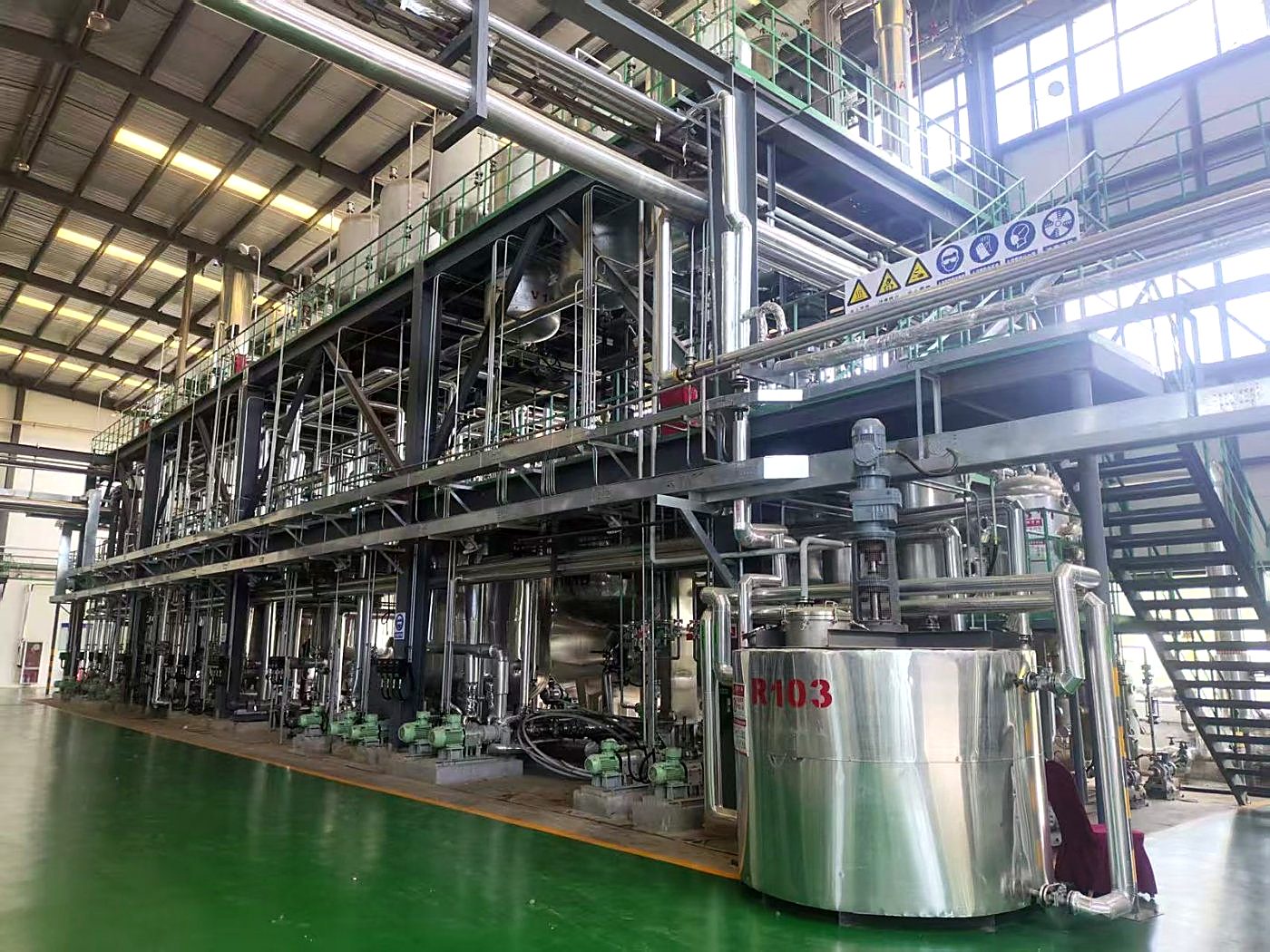
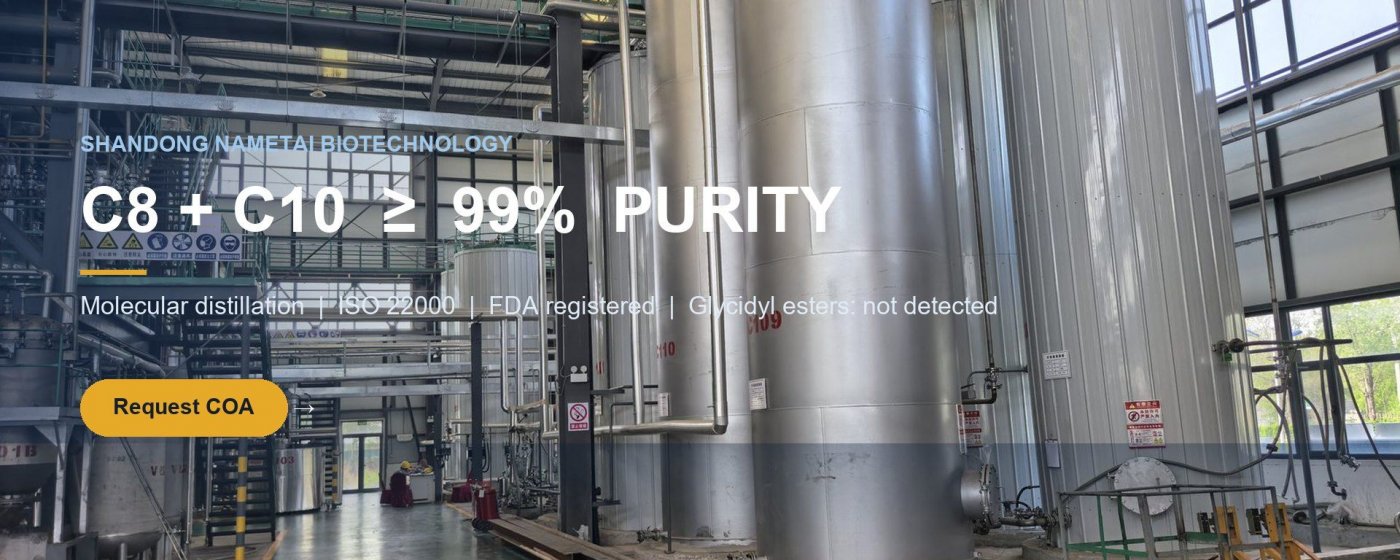
Verify the factory: the Nametai production line in Dongying, Shandong.
Once you know who manufactures the material, verify the site. What you are looking for:
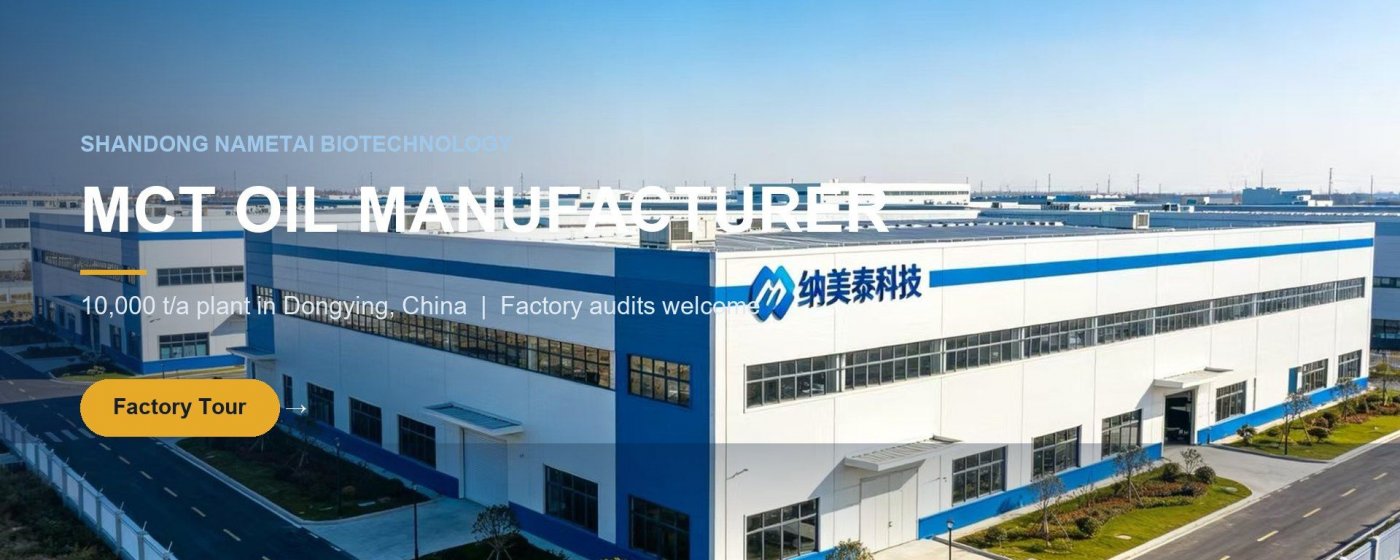
- A real facility with a stated capability. Ask for the process route — for MCT oil that means fractionation, esterification, distillation and separation, plus whatever finishing stage the pharmaceutical grade requires — the site area and the production capacity. For reference, our own plant in the Yellow River Delta Agricultural High-tech Zone in Dongying runs esterification, molecular distillation and separation with a dedicated pharmaceutical-grade finishing stage, on a 5,220 m² site with an annual capacity of 10,000 tonnes.
- Evidence you can see. A photo tour of the production building, processing equipment, packing line and warehouse is a reasonable starting point, but it should describe a real plant rather than illustrate a concept. Our factory page documents the workshop, equipment, drum packing and finished-goods warehouse, and the on-site videos were filmed at the plant.
- Access. The strongest available signal is whether the supplier welcomes an on-site audit and a third-party inspection body. We welcome customer visits and audits by SGS, BV, Intertek, TÜV or a buyer's own auditor, and can arrange a live video walkthrough for buyers who cannot travel.
Travel is not always possible, and that is fine — but the willingness to be visited is itself data, and a supplier who deflects the question indefinitely is telling you something that no brochure will.
4. Review Product Specifications
A specification is where a supplier's real capability becomes visible, because it is the document that has to survive your own technical review. Ask for a version-controlled sheet and read it in three passes. First, completeness: is there a full parameter panel with units, limits and typical values, and is a test method attached to each parameter? A limit without a method cannot be verified, and a panel that reports only the flattering parameters is not a specification. Second, the parameters that define the grade: for MCT that means the fatty-acid composition, reported with C8 and C10 separately, and the caps on the other fractions. A panel that shows only C8 and C10 leaves the distribution undefined; C6, C12, C14 and above-C16 limits are what separate a genuine MCT from a lauric-heavy material described as one. Third, the commercial constants: acid value, peroxide value, moisture and the physical constants your process depends on. Watch the units, because peroxide value is quoted in mmol/kg by Chinese and European laboratories and in meq/kg in many American documents, and a unit mismatch produces a factor-of-two error.
For pharmaceutical-grade material the standard should be named; the pharmaceutical-grade MCT oil we supply is produced to the requirements of the Chinese Pharmacopoeia (ChP 2025, Volume IV), with the pharmacopoeial method listed against each parameter. If you are buying powder, the declaration is longer and includes total fat, surface oil, granularity, carrier, moisture, ash and plasticizer limits; the full item-by-item list is set out in our MCT powder specification guide. Treat published typical values as indicative only — they come from routine production and are not a guarantee for your batch; the batch certificate is the document that binds a specific lot.
5. Request Samples
A sample is the cheapest risk reduction available, and in cross-border sourcing it does three jobs at once: it tests the material, it tests the documentation chain, and it tests how the supplier handles a small, awkward request. Ask for a sample from the production line that will supply you, not from retained pilot stock, and ask for the batch certificate to accompany it. Match the pack size to your intended trial — 1 kg is usually sufficient for laboratory work, and 20 kg is more useful for a process trial on production equipment; samples are available from us in 1 kg or 20 kg quantities, with sample quantities adjustable to customer requirements. Keep the certificate on file with your trial results, because if a later production lot differs from the sample, that file is what makes the comparison objective.
6. Review COA, TDS and Quality Documentation

Documentation is only as good as the laboratory behind it.
This is the stage where a supplier's documentation practice becomes visible, and it is worth running deliberately rather than accepting whatever arrives. Ask for, at the enquiry stage: a batch COA with measured values, identifying the batch and showing the specification limit, the measured result and the method for each parameter, since a certificate that says "conforms" on every line tells you a template exists rather than that a lot was tested; a technical data sheet covering storage, shelf life, handling and intended applications; third-party test reports for the parameters the in-house laboratory does not cover, typically heavy metals, plasticizers and microbiological items; and certificates and licences issued in the manufacturer's name, with their scope checked against the claim.
On certificates, keep the scopes straight. A management-system certificate is not a GMP certificate; a food safety certification such as HACCP is not a product approval; a US FDA food facility registration registers a facility rather than approving a product; and a Halal certificate is only relevant to your product if the product appears in its scope or annex. Our own position is published rather than asserted: the certificates we hold — ISO 9001, ISO 22000, ISO 14001, ISO 45001, HACCP, Halal, Kosher, a US FDA food facility registration and a China food production licence — are scanned in the certification section with the issuing body visible, and we state plainly that we do not hold a GMP certificate, a pharmacopoeial monograph approval, a DMF or a CEP.
For pharmaceutical applications, ask for the excipient filing reference. In China this is a filing on the CDE public platform, identifiable by filing number and by a status flag; an activated record is marked "I" and is available for a drug applicant to cite. Ours is F20260000425, for medium-chain triglycerides, currently held in active status — and it takes a few minutes to look up, which is exactly why you should. What a filing is not is a product approval; our CDE filing article sets out the distinction, and how the batches behind those certificates are tested is described in Quality & Compliance.
7. Confirm MOQ, Lead Time and Packaging
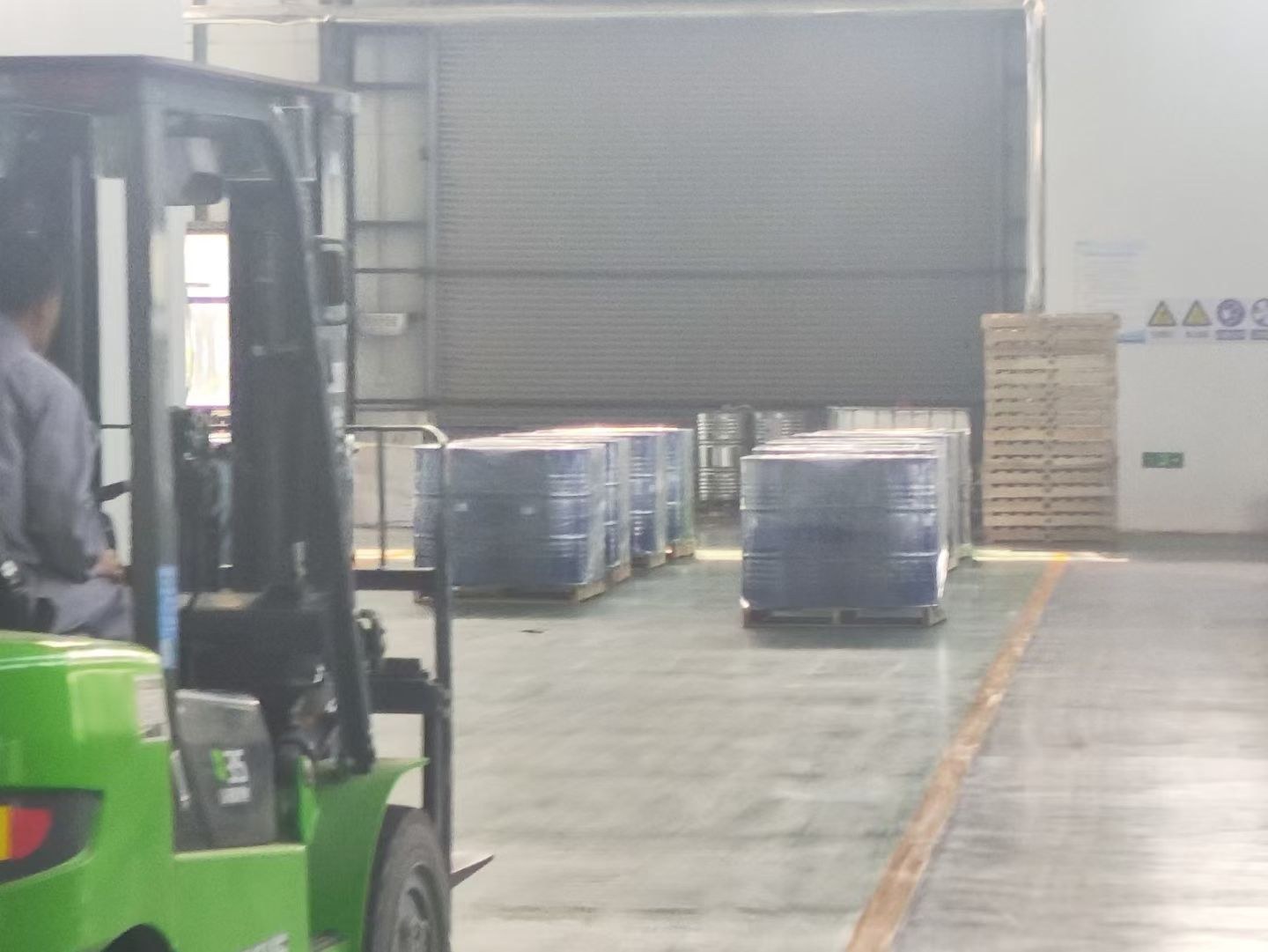
Lead time and packaging are confirmed before the trial order ships.
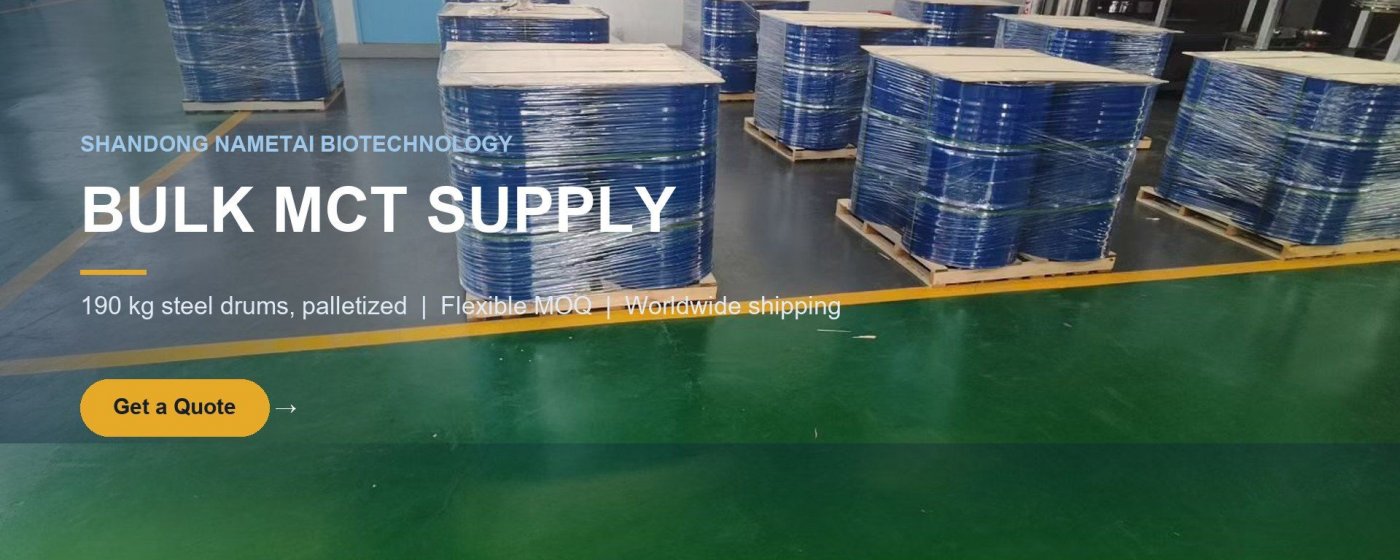
Commercial terms determine whether you can run a meaningful trial before committing, so ask for them in writing alongside the specification rather than after the price. Our standard terms, for reference: a minimum order quantity of 1 kg across MCT Oil, MCT Powder and Specialty Esters; samples available in 1 kg or 20 kg; regular orders shipped within 7 days to the port of departure, and OEM or custom orders within 30 days from the order date. Standard bulk packing for MCT oil is a 190 kg iron drum, with a 25 kg plastic drum for small and medium batches, and bulk shipments can be arranged with four drums per pallet, stretch-wrapped for container loading. Payment terms are agreed upon according to the contract between both parties.
Three questions are worth asking about any lead time you are quoted. Is the figure production time or time to the port? What happens to it when a specification change or a private-label run enters the schedule? And which container types are actually available for your quantity, as opposed to which are listed on the website?
8. Discuss OEM/ODM Requirements
If your product needs something other than the catalogue grade — a specific C8:C10 ratio, a private-label pack, a custom packaging configuration — raise it early, because it changes lead time and sometimes the supplier. OEM and ODM services are available from us, and custom formulation requests can be evaluated according to product requirements. The word to listen for is evaluated: a supplier who guarantees at the first contact that any formulation is possible is running a sales process, while the useful answer describes what data would be needed to qualify the change. For a ratio change the sensible sequence is to qualify with measured data before scale-up — produce the trial quantity, test it, and confirm the composition on a certificate before the production lot is committed.
9. Evaluate Communication and Quotation
Communication quality is a leading indicator in cross-border sourcing, and it is observable long before an order exists. Watch for four things. Whether technical questions are answered technically — a question about your process should come back with a process answer, not a repetition of the catalogue. Whether answers arrive in writing, because commitments that exist only in a chat window tend not to survive a personnel change. Whether the supplier pushes back; a supplier who tells you that your requested ratio will be difficult, or that your target lead time is not realistic, is more useful than one who agrees to everything. And how the quotation is structured: a quotation that references a specification version, a pack size, an Incoterm and a validity date is a professional document, while a price in an email is not a quotation.
10. Confirm Export and Shipping Requirements
Do this before the first production order, not during it, because export documentation requirements depend on the product and the destination and the time to discover a gap is at the enquiry stage. Establish which documents the supplier can provide and which you need; depending on the product and destination, our documentation can include a Certificate of Analysis, a safety data sheet, a certificate of origin, a health certificate, and Halal or Kosher certification where required, with further requirements discussed at the enquiry stage. Note the wording: these are documents we are able to supply, and the definitive list for your order is confirmed in the order documents rather than on a web page. Also settle the practical shipping questions early — the Incoterm and the named port, who arranges the booking, whether the pallet configuration suits your container plan, and what markings and labels you require on the drums. The operational details are where a shipment is delayed at the port, not the chemistry.
B2B Supplier Evaluation Checklist
| Area | What to establish |
|---|---|
| Requirement | Grade, C8:C10 ratio, physical form, critical parameters — written down before contact |
| Identity | Who manufactures, at which site, on which process route |
| Verification | Factory evidence, audit access, third-party inspection accepted |
| Specification | Version-controlled sheet, complete panel, methods attached, units stated |
| Samples | From the supplying line, with the batch certificate, in a useful pack size |
| Documentation | Batch COA with measured values, TDS, third-party reports, certificate scopes checked |
| Regulatory | Excipient filing reference verified independently (if applicable) |
| Commercial | MOQ, sample sizes, lead time (production vs port), packaging, payment |
| Custom work | OEM/ODM capability and how a change would be qualified |
| Communication | Technical answers in writing; a structured, referenced quotation |
| Logistics | Incoterm, port, booking responsibility, palletisation, markings, documents |
Working with Nametai Biotechnology
Shandong Nametai Biotechnology Co., Ltd. manufactures MCT oil, microencapsulated MCT powder and fatty acid esters at its plant in the Yellow River Delta Agricultural High-tech Zone, Dongying, Shandong — a 5,220 m² site with an annual capacity of 10,000 tonnes running esterification, molecular distillation and separation, with a dedicated pharmaceutical-grade finishing stage. The product range covers food-grade, cosmetic-grade and pharmaceutical-grade MCT oil, a pure C8 grade, microencapsulated MCT powders at several oil loads, and specialty emollient esters.
Every batch is released against a full specification in our own laboratory, with fatty-acid profile by GC, acid value, peroxide value, moisture and impurities tested per lot, third-party verification for heavy metals, plasticizers and microbiological items, and retained samples for batch traceability. For buyers running a formal evaluation, the useful starting points are the factory page, the Quality & Compliance section and the published certificates. We support factory visits and third-party audits by appointment, and we are happy to answer a target specification with a specification sheet, a sample and a sample batch COA rather than with a brochure.
FAQ
How can I verify an MCT oil manufacturer in China?
Establish who manufactures the material and where, ask for process and capacity information, request the specification and a batch COA with measured values, check certificate scopes against the claims, and use the available access routes — a factory visit, a third-party audit or a live video walkthrough. For pharmaceutical use, verify the excipient filing on the CDE public platform yourself.
Should I buy from a manufacturer or a trading company?
Either can work. What matters is knowing which one you are dealing with, and making sure the qualification covers the entity that actually produces the material, since that is where the certificates, batch records and audit access sit.
Can I request samples before placing an order?
Yes, and you should. Samples are available in 1 kg or 20 kg quantities, with sample quantities adjustable to customer requirements, and they should be accompanied by the batch certificate for the sample lot.
What is the minimum order quantity?
The minimum order quantity is 1 kg for MCT Oil, MCT Powder and Specialty Esters.
How long does shipping take?
Our standard terms are 7 days to the port of departure for regular orders, the same window for samples depending on quantity, and 30 days from the order date for OEM or custom orders. Time to the final destination depends on the shipping route and is arranged per order.
What documents come with a shipment?
A batch COA carrying the actual test results is issued with every shipment. TDS can be provided with shipment or upon request, and further documentation — including certificate of origin, health certificate, MSDS and Halal or Kosher certification where required — can be discussed at the enquiry stage.
Related Pages
- Products: MCT Oil · Pharmaceutical Grade MCT Oil · MCT Powder · Specialty Esters · Applications
- Verification: Inside our factory · Quality & Compliance · Certification
- Sourcing guides: Choosing an MCT oil manufacturer for pharmaceutical applications · Documents to request from an MCT oil supplier · How to evaluate an MCT powder supplier · MCT powder specification checklist
Request a Quote
For a quotation, a specification sheet, a sample (1 kg or 20 kg) or a sample batch COA, use the enquiry form on this page — request a quote — or the Contact Us page. The minimum order quantity is 1 kg for MCT Oil, MCT Powder and Specialty Esters.