
 +8613295467567



Choosing an MCT oil manufacturer for a pharmaceutical application is not the same exercise as buying food-grade material. The substance may carry the same INCI name and a similar certificate of analysis, but the release discipline, the documentation trail and the regulatory position behind it are what decide whether your formulation can move forward. This guide sets out what to check, in the order a supplier qualification process usually uncovers it.
Why Manufacturer Selection Matters for Pharmaceutical MCT Oil
Medium-chain triglycerides are an excipient in this context, not a flavouring or a sports nutrition ingredient, and that changes the consequence of getting it wrong. An excipient sits inside a registered product, so its specification has to be defensible not only to your QA department but, in many markets, to a regulator reviewing your dossier. It also changes the documentation a supplier must produce on demand: for food applications a specification sheet and a batch certificate are usually sufficient, while pharmaceutical use typically also requires the analytical methods behind the limits, stability information, a defined change-control route and — where the material will be cited in a registration — an identifiable regulatory record. A manufacturer that cannot assemble that package is not necessarily a bad manufacturer; it is simply a food-grade supplier, and the two are worth keeping distinct.
1. Check the Supplier's Pharmaceutical-Grade Positioning
"Pharmaceutical grade" is a phrase, not a specification. A defensible answer names a pharmacopoeia or a written customer specification and confirms that the material is tested against those methods. A concrete example is easier to evaluate than a claim. The pharmaceutical-grade MCT oil we manufacture at our Dongying plant is produced to the requirements of the Chinese Pharmacopoeia (ChP 2025, Volume IV) and released as an excipient and carrier for topical and oral preparations and as a high-purity base for cosmetic formulations. Its specification is published with the pharmacopoeial method attached to each parameter — identification by GC against reference standards, relative density, refractive index, viscosity, acid value, hydroxyl value, iodine value, peroxide value, saponification value, clarity and colour of solution, unsaponifiable matter, water and residue on ignition.
Two questions expose the difference between a grade claim and a grade capability. Which pharmacopoeia, and which edition? A supplier who answers "pharmaceutical grade" without naming a standard has not answered. And is the pharmaceutical grade a separate production route or a re-labelled food grade? Food-grade, cosmetic-grade and excipient-grade MCT are the same molecule with different release requirements; a supplier who markets them interchangeably is telling you something about their documentation habits.
2. Verify Regulatory and Excipient Filing Evidence
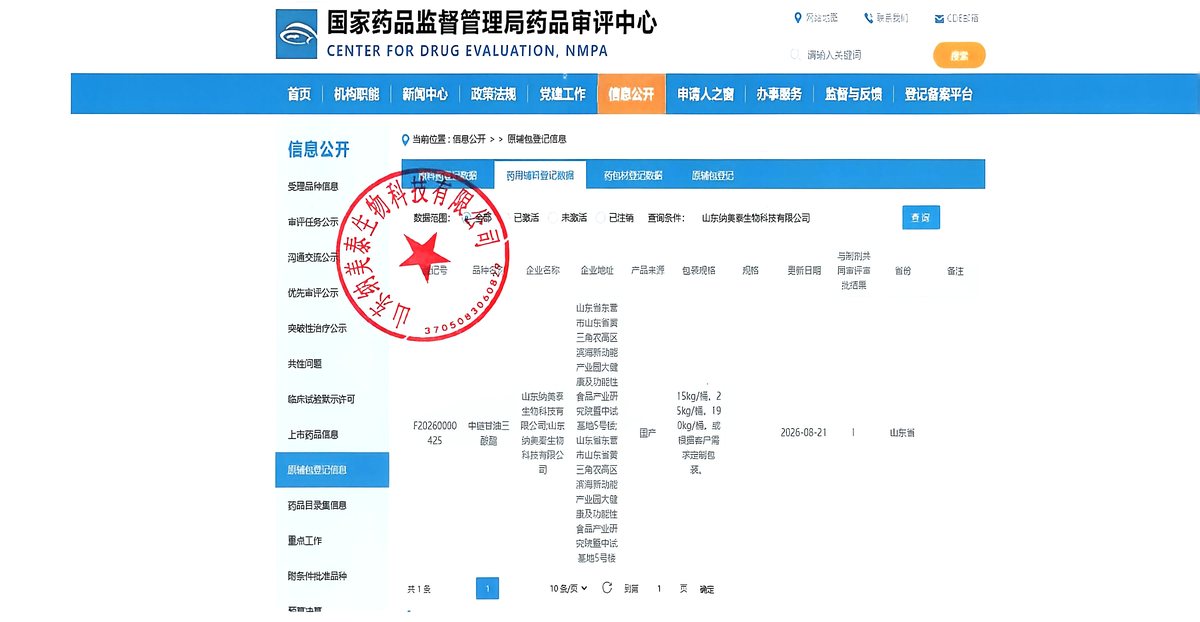
Public regulatory evidence: the CDE excipient filing F20260000425.
In China, pharmaceutical excipients are no longer registered as standalone approvals. Under the marketing authorization holder regime, a manufacturer files its manufacturing description, quality standard and stability data on the public excipient filing platform of the Center for Drug Evaluation (CDE) of the National Medical Products Administration (NMPA), and the record is then reviewed in association with the drug applications that reference it.
The platform is public and searchable by company name, product name or filing number, and each record shows the filer, the product name, packaging options, the update date and a status flag. An activated record is marked "I": it means the submitted dossier is complete and available for a drug applicant to cite, while a record that has not been activated cannot be cited. Our own filing is number F20260000425, for the product medium-chain triglycerides, filed by Shandong Nametai Biotechnology Co., Ltd. and currently held in active status. Look it up on the CDE platform yourself before you cite it in a dossier — a regulatory record is only worth what independent verification says it is worth.
One distinction matters here, and it is the one most often blurred in supplier marketing. An excipient filing is an activation, not a product approval. The dossier is reviewed in association with each drug application that cites it, and your formulation, route of administration and specification fit remain subject to review. What the filing establishes is that a complete, regulator-held technical dossier exists and is available to be referenced; it is not an approval of your product, and it is not a substitute for your own qualification work. The same discipline applies to every other regulatory claim: a US FDA food facility registration registers a facility, and is not an FDA product approval. Our position is stated plainly on our quality and compliance pages — we do not claim a GMP certificate, a pharmacopoeial monograph approval, a DMF or a CEP that we have not been issued.
3. Evaluate Manufacturing and Quality Control
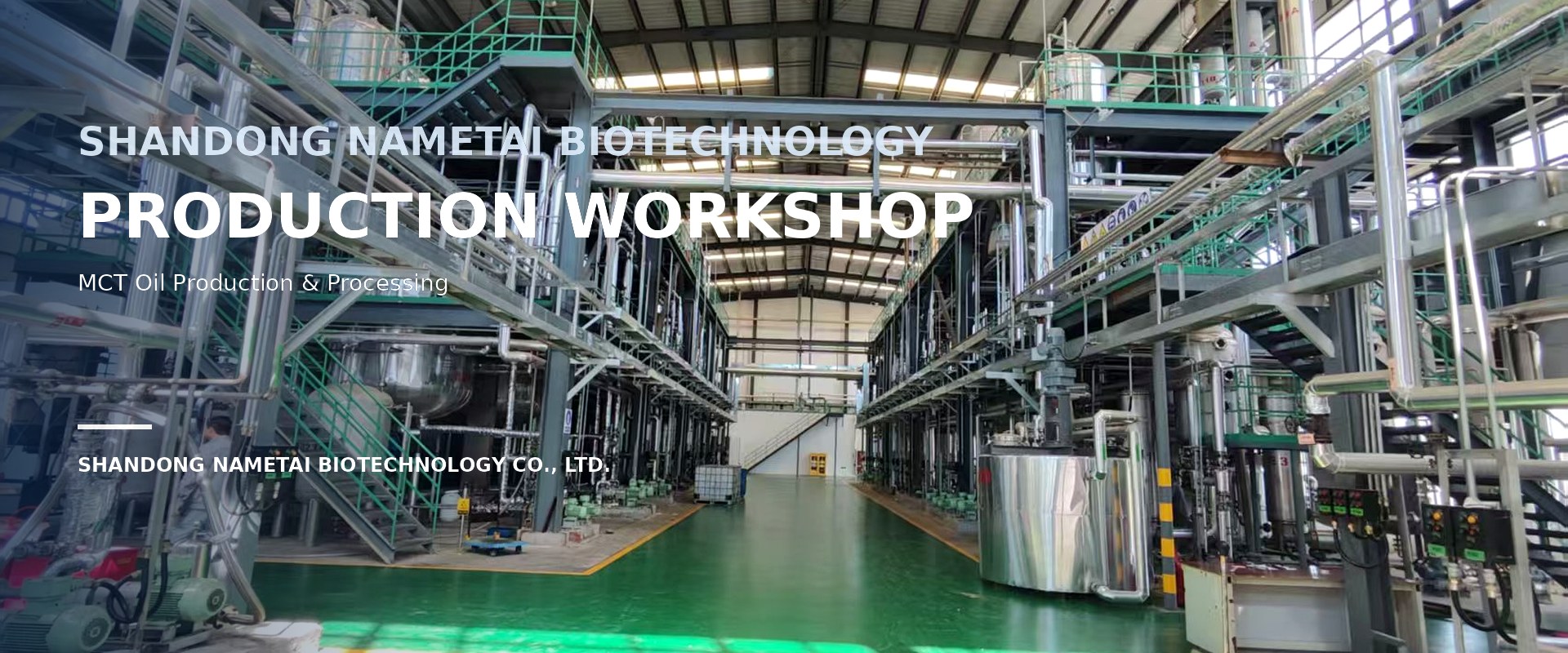
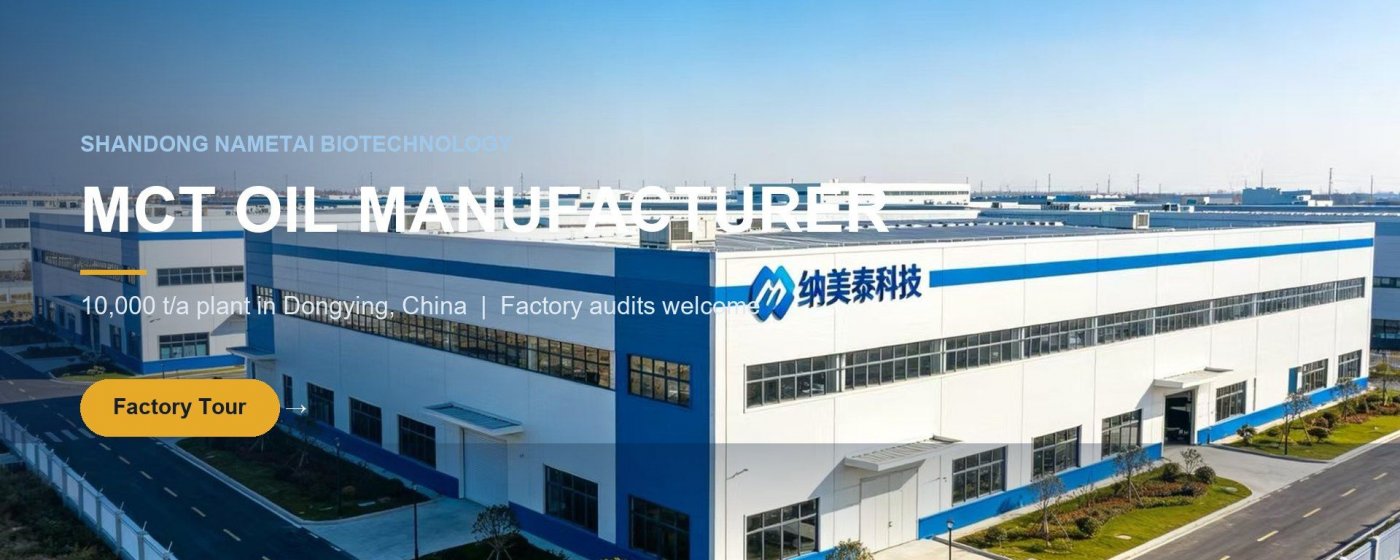
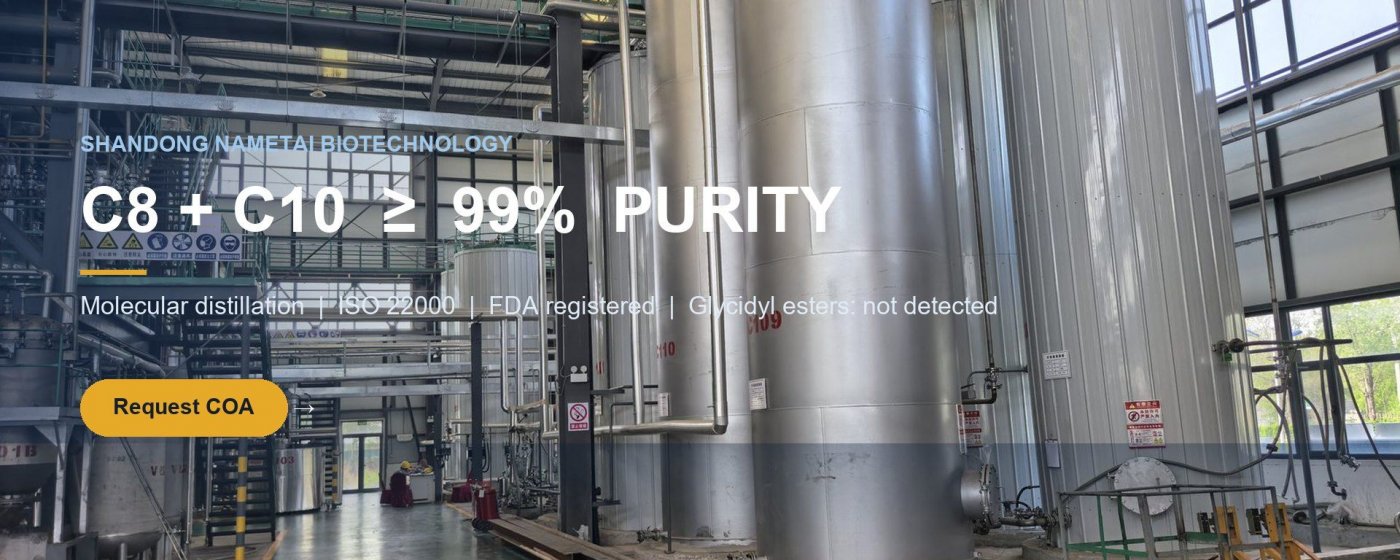
Manufacturing you can verify: the Nametai production workshop in Dongying.
Ask who manufactures the material and where. A trading company can be a perfectly reasonable commercial partner, but if the answer to "who makes it" is another company, then that company is the one your audit needs to cover. For a producer, the useful questions are about the process route and the release routine rather than the size of the brochure. MCT oil is produced by esterification of the medium-chain fatty acids followed by distillation and separation, and the finishing route is where pharmaceutical grades separate from food grades. Our own plant in the Yellow River Delta Agricultural High-tech Zone in Dongying runs esterification, molecular distillation and separation, with a dedicated pharmaceutical-grade finishing stage, on a 5,220 m² site with an annual capacity of 10,000 tonnes.
On quality control, the key question is what happens to every batch. In our laboratory each lot is released against a full specification — fatty acid profile by gas chromatography, acid value, peroxide value, moisture and impurities — with heavy metals and microbiological items verified through third-party reports and retained samples kept per batch so a delivered lot can be traced back to its production record.
Two follow-ups are worth asking. What instrument is the fatty-acid profile run on? Composition by GC is the test that actually defines an MCT grade, and the instrument and method tell you whether the number is meaningful; our laboratory runs an Agilent 7890B GC system with a headspace autosampler. And which parameters are batch-tested and which are type-tested? Heavy metals, plasticizers, mycotoxins and pathogens are usually tested at type-inspection frequency rather than on every lot. A supplier who can distinguish the two has read their own specification; a supplier who claims everything is tested on every batch has not.
4. Ask for COA and Technical Documentation
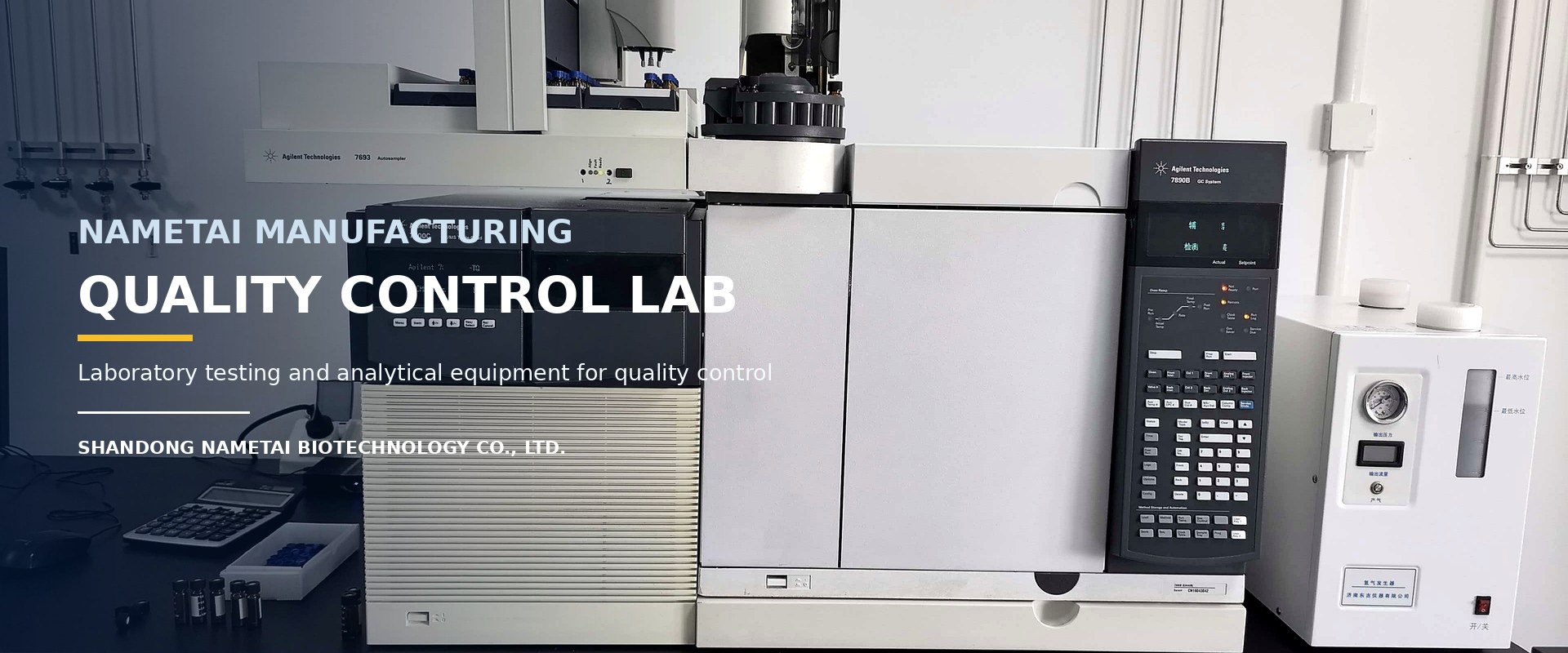
Batch-release testing happens in the factory QC laboratory.
The documentation set is as much a part of a pharmaceutical product as the oil itself, and it is worth requesting before you request a price, because the answer tells you how the rest of the project will go. The core set is a batch COA with actual measured values — not a template, and not a page that says "conforms" on every line; a technical data sheet with a version number and effective date; third-party laboratory reports for the parameters the in-house laboratory does not cover; certificates and licences issued in the manufacturer's name; and a sample drawn from the production line that will supply you. We issue a batch COA carrying the actual test results with every shipment and can provide a technical specification sheet in English and Chinese; TDS can be supplied with shipment or on request, and third-party laboratory reports are available on request. What matters more than our own practice is the habit you are testing: a supplier who sends a complete, batch-specific document set at the enquiry stage is usually also the supplier whose documents match the goods at the port.
5. Compare Specifications, Not Just the Product Name
Two suppliers can both offer "pharmaceutical grade MCT oil" and still not be offering the same material, because the grade name does not fix the numbers. Compare the parameter panel directly; the parameters that carry the most weight for pharmaceutical use are the fatty-acid composition, the identity tests and the physical constants your process depends on. For reference, the pharmaceutical-grade MCT oil we supply declares the following:
| Parameter | Unit | Specification | Typical |
|---|---|---|---|
| Relative density (20 °C) | — | 0.93 – 0.96 | 0.95 |
| Refractive index (20 °C) | — | 1.440 – 1.452 | 1.449 |
| Viscosity (25 °C) | mPa·s | 25 – 33 | 29 |
| Acid value | mg KOH/g | ≤ 0.2 | 0.1 |
| Peroxide value | meq/kg | ≤ 1.0 | 0.0 |
| Saponification value | mg KOH/g | 310 – 360 | 350 |
| Water | % | ≤ 0.2 | 0.06 |
| Caprylic acid C8:0 | % of total FA | 50.0 – 80.0 | 61.2 |
| Capric acid C10:0 | % of total FA | 20.0 – 50.0 | 38.8 |
| Lauric acid C12:0 | % of total FA | ≤ 3.0 | 0.0 |
Three habits make this table useful rather than decorative. Insist on the unit: peroxide value is quoted in mmol/kg by Chinese and European laboratories and in meq/kg elsewhere, and a factor-of-two error introduced at the quotation stage tends to surface at the port. Treat the C8:C10 ratio as a design choice rather than a quality ranking; 60:40 and 70:30 are both standard, and the right one depends on your formulation. And check whether the caps on the non-MCT fatty acids (C6, C12, C14 and above C16) are declared at all, because a panel that reports only C8 and C10 is hiding the ends of the distribution. Published typical values, meanwhile, are indicative figures from routine production, not a guarantee for the batch you receive; the batch certificate is the document that binds a specific lot.
6. Check MOQ, Samples, Lead Time and Packaging
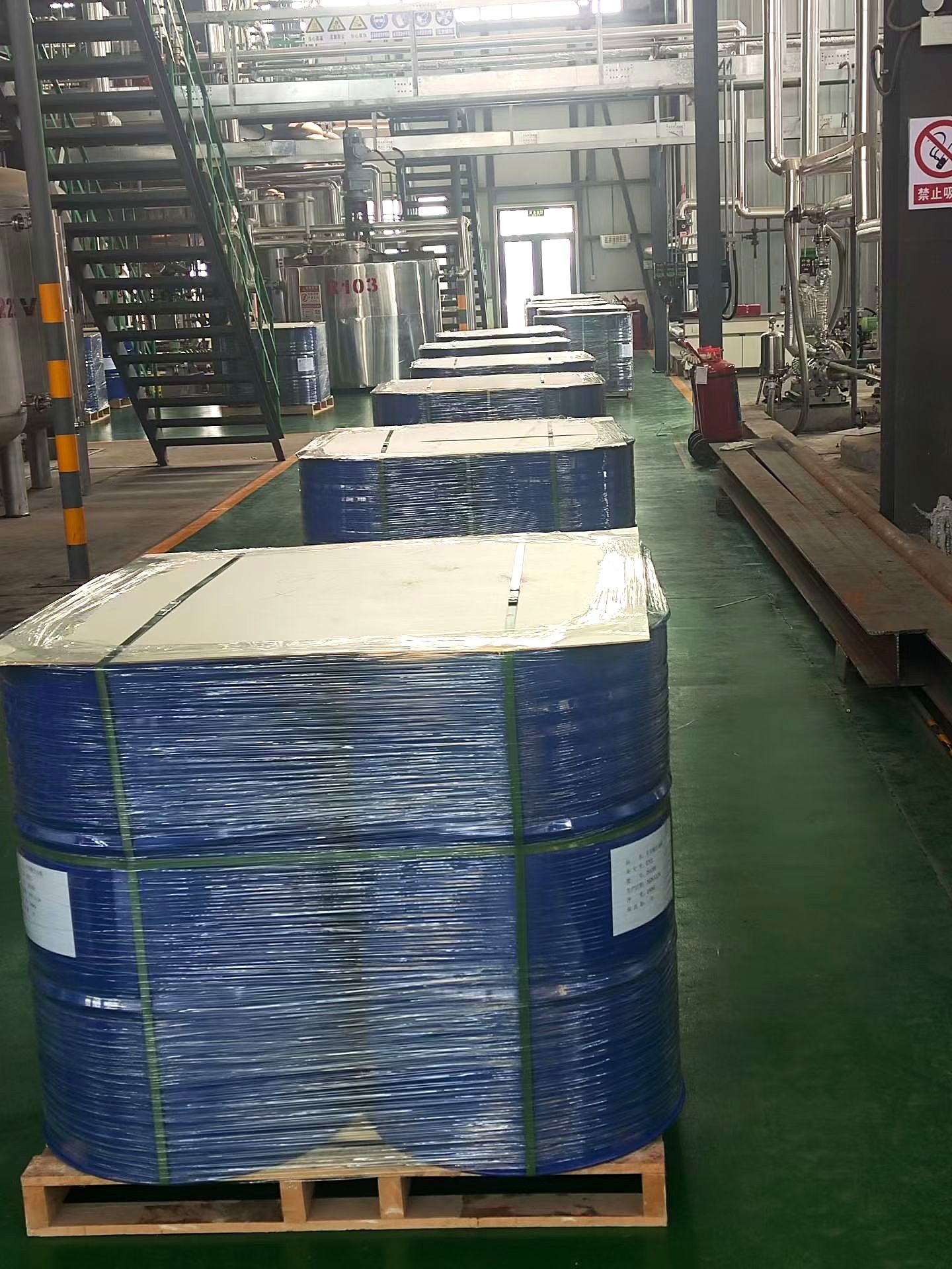
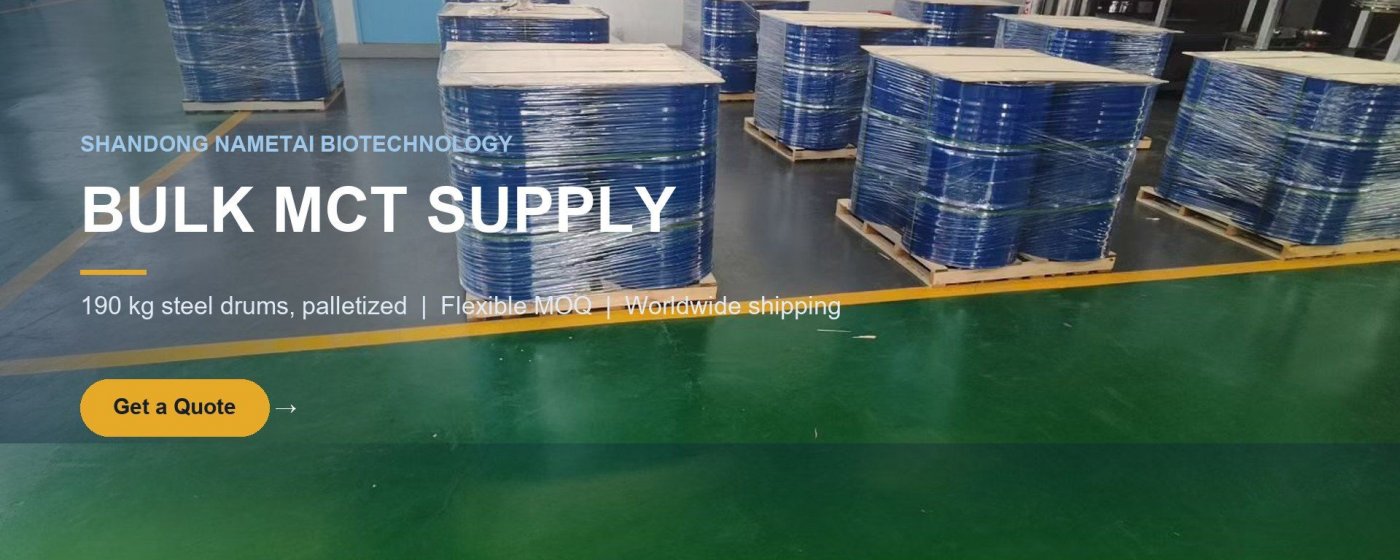
Standard export packaging: 190 kg steel drums, palletised and stretch-wrapped.
Commercial terms are part of supplier qualification, because they determine whether you can run a meaningful trial before committing to a lot; ask for them in writing, in the same document as the specification. Our standard terms are a minimum order quantity of 1 kg across MCT Oil, MCT Powder and Specialty Esters; samples available in 1 kg or 20 kg quantities, adjustable to customer requirements; and regular orders shipped within 7 days to the port of departure, with OEM or custom orders within 30 days from the order date.
On packaging, the answer should be specific about containers, not just weights. Our standard bulk container for MCT oil is a 190 kg iron drum, with a 25 kg plastic drum for small and medium batches and 1 kg packs for samples and trials; bulk shipments can be arranged with four drums per pallet, stretch-wrapped for container loading. Payment terms are agreed upon according to the contract between both parties — a normal arrangement, but one worth confirming early, since it is the point at which a promising supplier sometimes turns out to want the whole order prepaid.
7. Ask About OEM/ODM and Custom Requirements
If your formulation needs something other than the catalogue grade — a particular C8:C10 ratio, a private-label pack, a specific packaging configuration — establish early whether the manufacturer can do it and how it will be qualified. OEM and ODM services are available from us, and custom formulation requests can be evaluated according to product requirements. Note the wording: evaluated. Any manufacturer who tells you at the first email that every custom formulation is possible is describing a sales process, not a technical one; the useful answer describes what data would be needed to qualify the change and what it would cost in lead time.
A Practical Checklist for Evaluating an MCT Oil Manufacturer
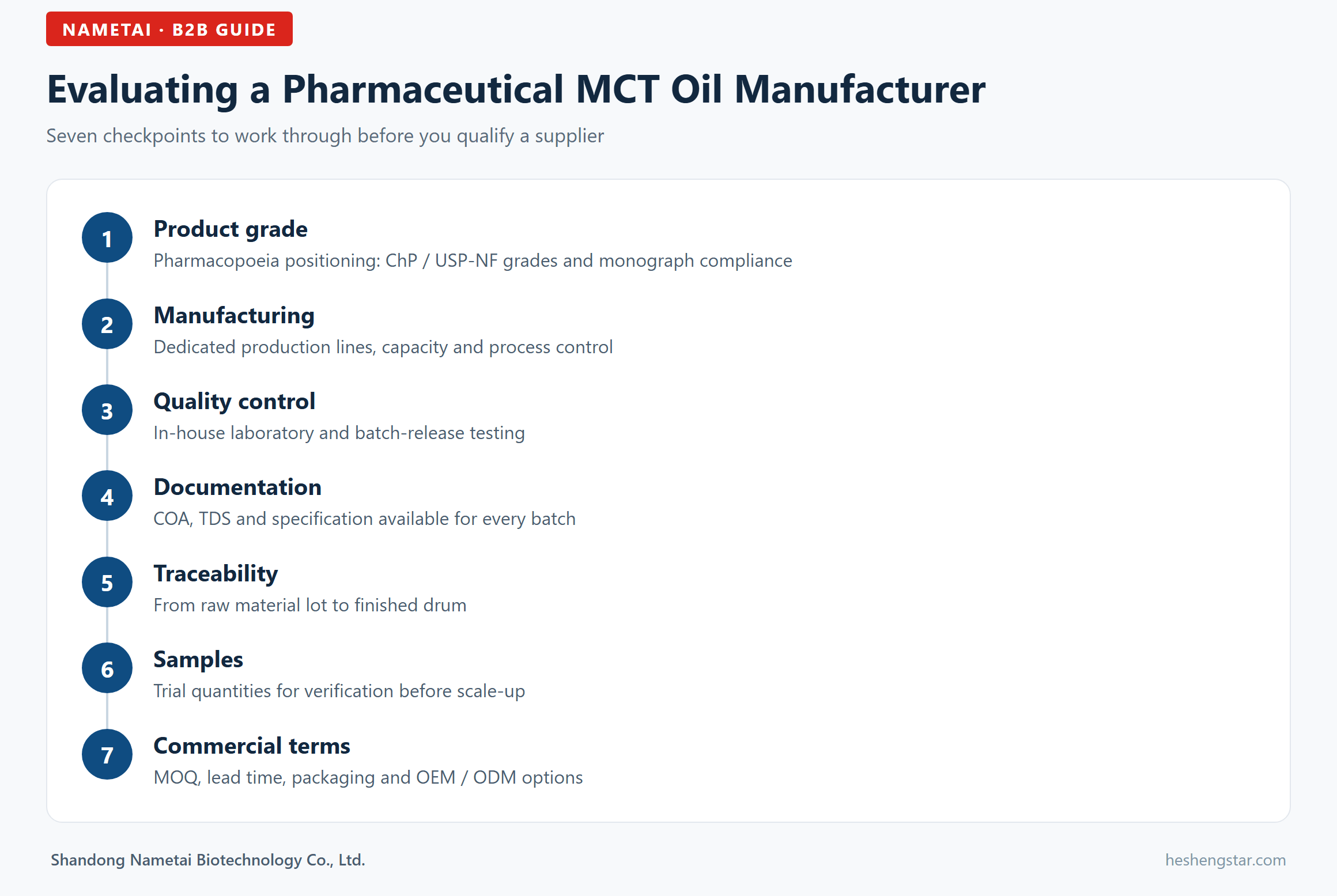
Seven checkpoints when qualifying a pharmaceutical MCT oil manufacturer.
| Stage | What to request | What a good answer looks like |
|---|---|---|
| Grade position | The standard the material is released against | A named pharmacopoeia or a written customer specification, with methods |
| Regulatory | Excipient filing number and status, plus certificate scopes | A searchable filing record in active status; certificates whose scope matches the claim |
| Manufacturing | Who manufactures, where, on what process route | A named production site and a described finishing route |
| Quality control | Per-lot test panel, instruments, third-party coverage | A defined per-batch panel, named methods, and a clear split between batch and type testing |
| Documentation | Batch COA, TDS, specification sheet, third-party reports | Batch-specific documents with measured values, available at the enquiry stage |
| Specification | Full parameter panel with limits and typical values | A complete panel that includes the non-MCT fatty-acid caps |
| Commercial | MOQ, sample sizes, lead time, packaging, payment | Written terms, production time distinguished from shipping time, specific container types |
| Custom work | OEM/ODM capability and qualification route | A defined evaluation process with a data-based qualification step |
| Verification | Factory visit, audit, video tour, retained samples | Visits and third-party audits welcome by appointment |
What Overseas Buyers Can Verify with Nametai
Shandong Nametai Biotechnology Co., Ltd. manufactures MCT oil, microencapsulated MCT powder and fatty acid esters at its plant in the Yellow River Delta Agricultural High-tech Zone, Dongying, Shandong. The pharmaceutical-grade MCT oil line is produced to ChP 2025 Volume IV requirements, with the excipient filing F20260000425 held in active status on the CDE platform.
Every batch is released against a full specification in our own laboratory, with third-party verification for heavy metals, plasticizers and microbiological items and retained samples kept for batch traceability. The site holds ISO 9001, ISO 22000, ISO 14001 and ISO 45001 management-system certificates, HACCP certification, Halal and Kosher certificates, a US FDA food facility registration and a China food production licence — all issued in the company's name, so each can be checked independently. Scans are published in the certification section.
For buyers who need to look before they buy, we support factory visits and third-party audits by appointment and can arrange a live video walkthrough of the production and warehouse areas; the production building, processing equipment, packing line, warehouse and QC laboratory are documented on our factory page, and the release routine is described in Quality & Compliance. Two limitations are worth stating openly, because they are the ones buyers discover late: we do not hold a GMP certificate, a pharmacopoeial monograph approval, a DMF or a CEP, and we do not claim any of them; and the CDE filing is an activation available for citation, not an approval of any particular drug product.
FAQ
What should I check before buying pharmaceutical-grade MCT oil?
Establish which standard the material is released against, verify the regulatory record yourself, confirm who manufactures it and where, ask for the per-batch test panel, and request a complete documentation set with a sample before agreeing commercial terms.
Is pharmaceutical grade the same as food grade MCT oil?
It is the same substance released against a different standard with a different document set. The practical differences sit in the identity tests, the tighter physical constants, the analytical methods attached to each limit and the regulatory paperwork — not in the INCI name.
Does an active CDE excipient filing mean the product is approved?
No. It means the manufacturer's technical dossier is filed and available for a drug applicant to cite, and that it is reviewed in association with each application that references it. It is an activation, not a product-specific approval.
Can I visit the factory or send an auditor?
Yes. We welcome customer visits and third-party audits (SGS, BV, Intertek, TÜV or your own inspection body) by appointment, and can arrange a live video walkthrough for buyers who cannot travel to Dongying.
What are the sample sizes and documents provided?
The minimum order quantity is 1 kg across MCT Oil, MCT Powder and Specialty Esters, and samples are available in 1 kg or 20 kg quantities. A batch COA carrying the actual test results is issued with every shipment; TDS can be provided with shipment or upon request, and third-party laboratory reports are available on request.
Related Pages
- Product: Pharmaceutical Grade MCT Oil · All MCT Oil grades
- Evidence: NMPA CDE excipient filing explained · Inside our QC lab · Quality & Compliance · Certification
- Manufacturing: Inside our factory
- Buying guides: Documents to request from an MCT oil supplier · Sourcing MCT oil from China · How to read an MCT oil COA · Pharmaceutical-grade vs food-grade MCT oil
Request a Quote
For a quotation, a sample (1 kg or 20 kg), a batch COA or the filing reference details for your regulatory dossier, use the enquiry form on this page — request a quote — or the Contact Us page. The minimum order quantity is 1 kg for MCT Oil, MCT Powder and Specialty Esters.