
 +8613295467567



Most MCT oil disputes between buyer and supplier are not about fatty acid composition — they are about contaminants: heavy metals, plasticizers, antioxidant residues, and the chlorinated ester families known as 3-MCPD esters and glycidyl esters. This article explains which contaminant questions a B2B buyer should ask, what our own testing shows, and where the honest limits of a supplier's statement lie.
Why contaminants, not composition, decide quality reputation
Fatty acid profile (C8:C10 ratio) is set by formulation and is easy to hold. Contaminants are different: they enter through raw materials, processing aids, equipment and packaging, and they are where a supplier's process discipline actually shows. A supplier can talk its way through a specification sheet, but contaminant data comes from instruments and third-party laboratories — or it does not exist.
Heavy metals: tested, reported, and verified externally
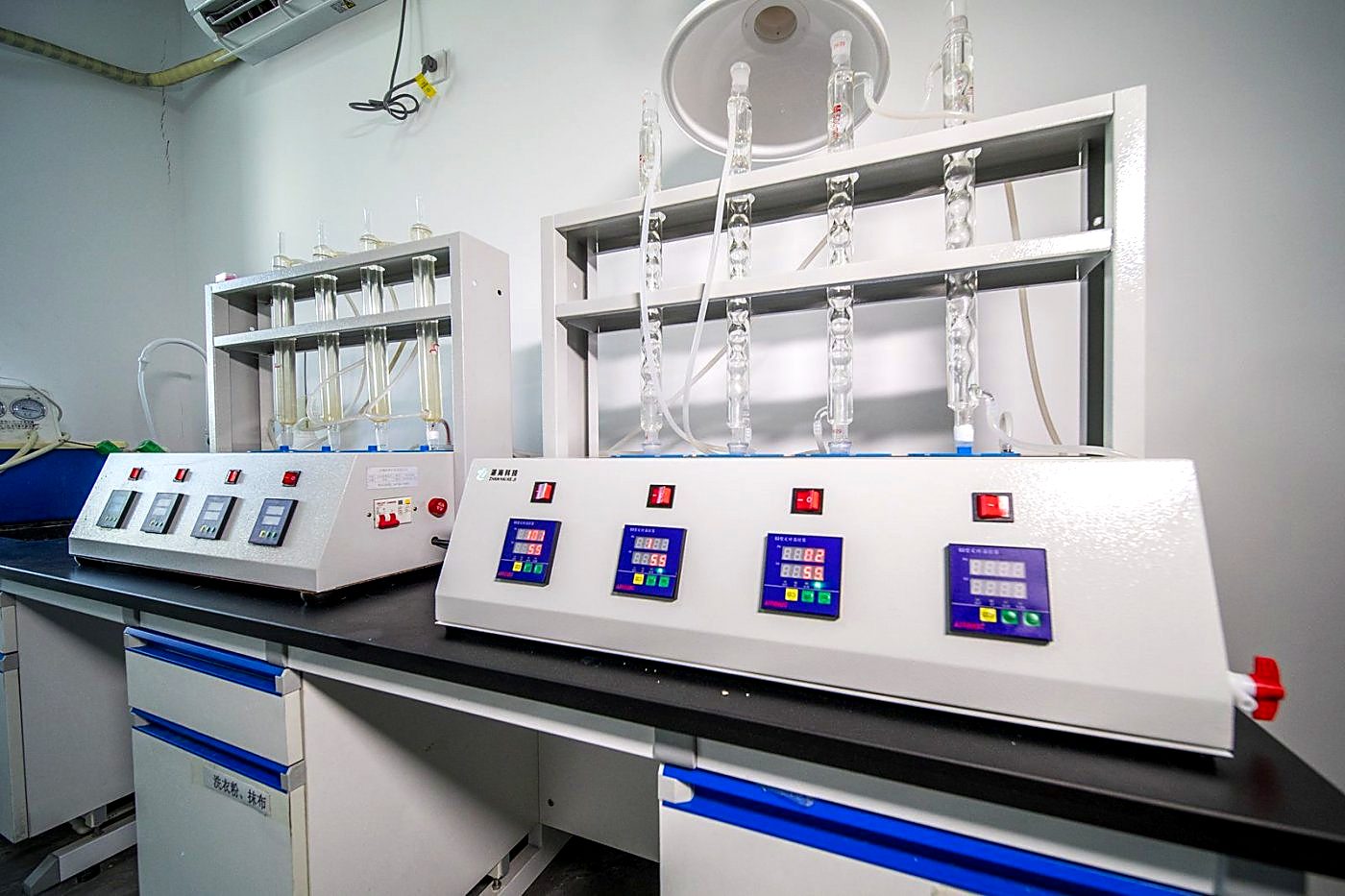
Contaminant control starts with testing, not with promises.
For our MCT oil, heavy metals are monitored according to food-grade requirements, and the verification is done by a third-party laboratory (CTI) rather than claimed from in-house results alone. Recent third-party reports show lead and arsenic not detected.
What a buyer should require from any supplier is not a single clean report but a routine: which metals, which method, how often, and by whom. "Not detected" means nothing without the method detection limit printed next to it. When you review a COA or third-party report, check that the reporting limit is stated — that single detail separates a monitoring program from a marketing document.
Plasticizers: the specification rows that should always be there
Plasticizers (phthalates) are a recognized monitoring point for oils and processed foods because they can migrate from processing equipment and packaging materials. Our specifications set explicit limits and test against them:
- DBP (dibutyl phthalate): ≤ 0.3 mg/kg
- DEHP (di(2-ethylhexyl) phthalate): ≤ 1.5 mg/kg
- DINP (diisononyl phthalate): ≤ 9.0 mg/kg
Recent results on our MCT oil and pure C8 grades show all three not detected. If a supplier's specification has no plasticizer rows at all, that silence is itself an answer — ask for the limits and the latest third-party results before you proceed.
Synthetic antioxidants: a "not detected" that matters
Synthetic antioxidants such as TBHQ, BHA and BHT are sometimes added to oils to extend shelf life. Our third-party testing shows none of the three detected in our MCT oil — the oil's stability comes from the refining process and low peroxide value, not from added antioxidants. For buyers formulating "clean label" products, this is a specification row worth having in writing.
3-MCPD esters and glycidyl esters: the honest position
3-MCPD esters and glycidyl esters are process contaminants that can form during oil refining at high temperatures. They matter to buyers because refined oils — precisely the oils used in food and nutraceutical applications — are the category where these compounds are monitored.
Our position is deliberately specific: these parameters are controlled in our process, and recent third-party testing has shown glycidyl esters not detected. What we do not do is claim a universal compliance statement for every market's future limits — regulatory limits for these compounds continue to evolve, and a supplier who claims permanent compliance with every future regulation is telling you something about their honesty. Batch-specific third-party results, on request, are the dependable form of evidence.
Oxidation: the contaminant family you create yourself
The contaminant that most often appears after the goods leave the factory is oxidation — and it is controllable on both sides. Peroxide value tracks early oxidation; acid value tracks hydrolytic breakdown. Our food-grade MCT oil typically shows peroxide value around 0.28 mmol/kg and acid value around 0.04 mg KOH/g — far inside limits. On your side, storage matters: cool, dry, sealed, away from sunlight and heat. Unopened shelf life is 24 months under recommended conditions. A batch that arrives clean can still arrive at your customer degraded if drums sit in the sun at a transit hub.
What to ask a supplier — the four-question screen
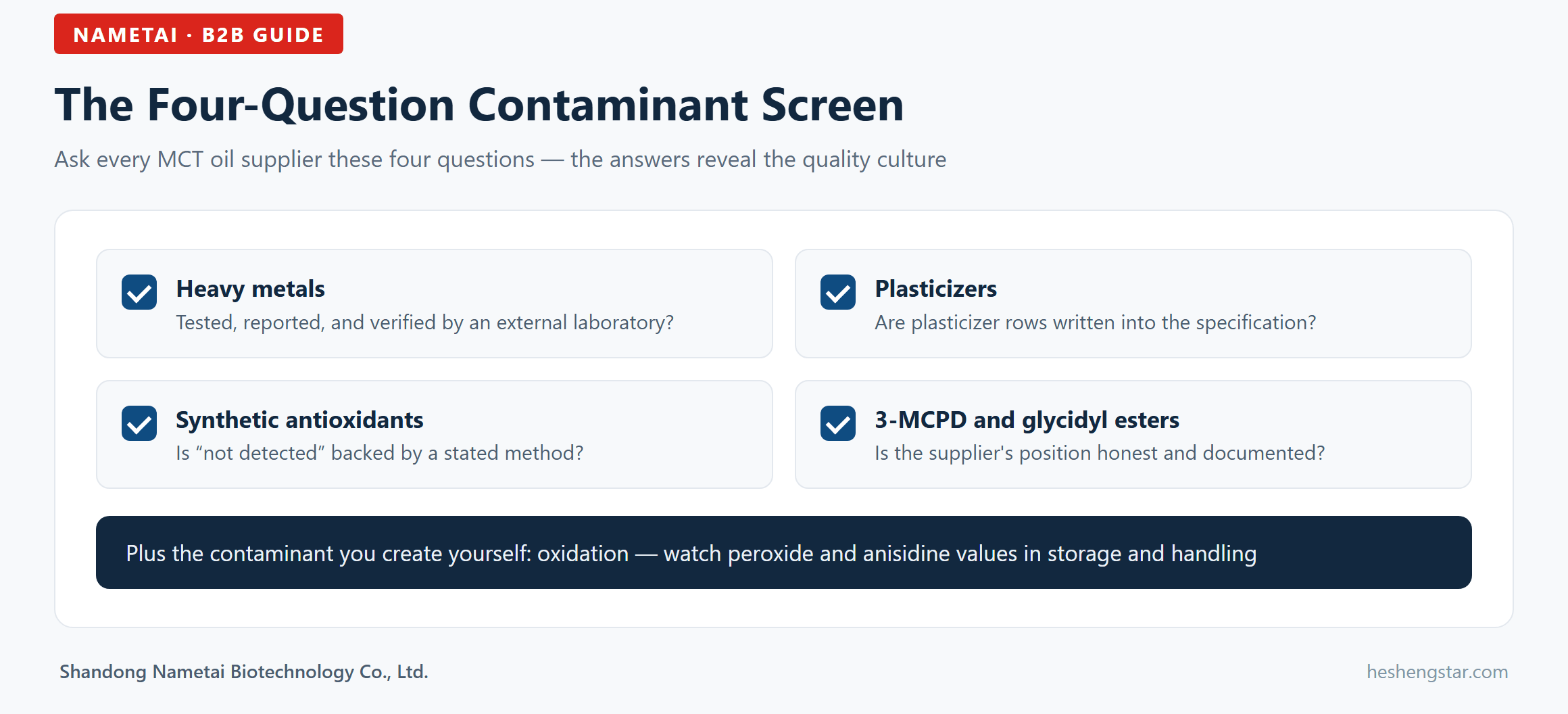
The four-question screen - plus the oxidation you create yourself.
- Which contaminants are in your routine specification, with which limits and methods?
- Which results come from a third-party laboratory, and can you share recent reports?
- What are your method detection limits for heavy metals?
- How are retained samples handled, and for how long?
A supplier confident in its numbers answers these on the spot. Our own quality system — in-house release testing on every batch, CTI third-party verification for heavy metals, plasticizers and microbiology, and retained samples per batch — is described on the Quality & Compliance page, and the QC laboratory article shows the equipment doing the testing.
Frequently asked questions
Are heavy metals tested on every batch?
Heavy metals are monitored per food-grade requirements and verified by third-party laboratory reports; recent results show lead and arsenic not detected. Every batch's in-house release covers the specification parameters, and third-party reports are available to buyers on request.
What are your plasticizer limits?
DBP ≤ 0.3 mg/kg, DEHP ≤ 1.5 mg/kg, DINP ≤ 9.0 mg/kg — written into the specification of our oils and powders, with recent third-party results showing not detected on all three.
Do you add synthetic antioxidants to your MCT oil?
No. Third-party testing shows TBHQ, BHA and BHT not detected. Stability comes from refining quality and low peroxide value, not additives.
Can you provide third-party test reports with the shipment?
Third-party laboratory reports can be provided on request, and a batch COA with actual test results is issued with every shipment as standard. Ask for the third-party package at the quotation stage and it will travel with the order.
How should we store MCT oil after receipt?
Cool, dry, tightly sealed, away from direct sunlight and heat. Unopened shelf life is 24 months under recommended conditions. Peroxide and acid values on the batch COA give you the baseline to verify your own storage performance over time.
Related reading
For the ten COA parameters worth checking first, see the COA ten-parameter guide. For the laboratory behind the results, see inside our QC lab. For the products these tests protect, see MCT Oil (Medium-Chain Triglycerides) and the Pharmaceutical Grade MCT Oil page.
Want the third-party report package with your next quotation? Use the enquiry form on this page — request a quote.